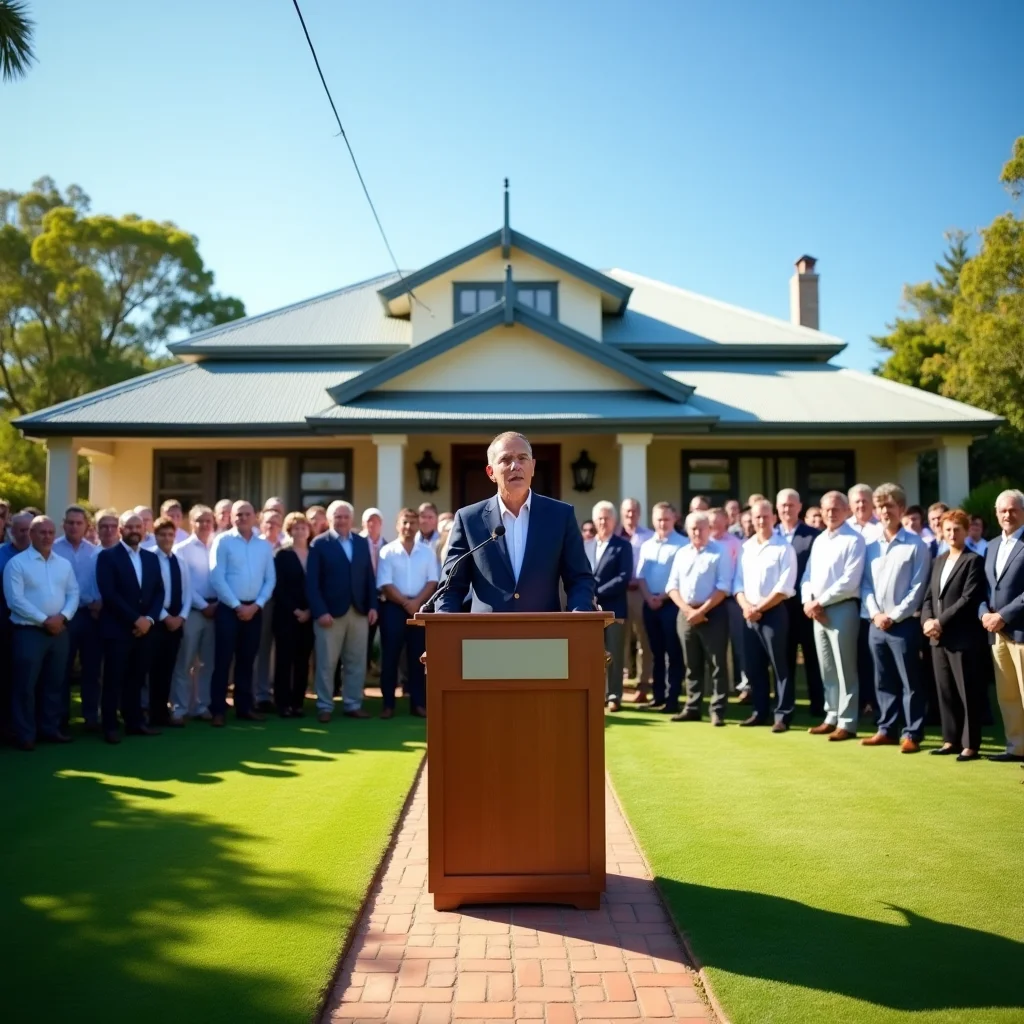
A Brisbane couple purchased a $1.2 million home they had never inspected for $290,000 below its valuation, at an auction they never planned to attend, according to REA Group, as the city's auction clearance rate sinks. The same outlet's broader reporting on the post-Budget market split frames this discount not as an isolated bargain but as a symptom of a national affordability divergence now visible at suburb level.
Suburb data across four states shows this divergence clearly. While Brisbane buyers are securing six-figure discounts at auction, Western Australia's premium suburbs are recording double-digit annual growth, and the gap between the two states' entry-level markets is widening in ways that matter for anyone pricing affordability right now.
A Brisbane Discount That Signals a Wider Split
The $290,000 gap between valuation and sale price in Brisbane did not happen in isolation. It follows the pattern REA Group describes in its post-Budget coverage — a market where some cities are falling while others quietly turn a corner. Brisbane's softening is not uniform even within its own boundaries. West End, a Brisbane-proximate QLD suburb, held a 62% clearance rate with 8.8% annual growth and a median of $1.35 million, while Indooroopilly posted a near-identical 62.5% clearance rate and 8.5% growth at $1.38 million. Both suburbs are performing well above the citywide softness implied in the couple's discounted purchase.
This internal split matters for vendors deciding how to price a campaign. A single city-level clearance rate figure masks meaningful variation between inner, lifestyle-adjacent pockets and broader metro stock, and the Brisbane case shows a buyer walked away with nearly a quarter-million-dollar discount in a market where neighbouring suburbs were still clearing above 60% at auction.
The Affordability Floor Across Four States
Entry-level pricing diverges sharply by state. Mandurah in Western Australia holds the lowest median in the dataset at $550,000, yet is growing at 10.5% annually with a 24-day selling cycle. Dandenong in Victoria sits at $680,000 but is growing at just 2.3%, with a 40-day cycle. Port Macquarie and Liverpool in New South Wales both sit at $850,000, but Port Macquarie is taking 48 days to sell with a 46% clearance rate, while Liverpool clears at 60.5% in 38 days.
The pattern is consistent: Western Australia's affordable suburbs are growing fastest and selling quickest, while New South Wales and Victoria's comparably priced stock is moving slower and clearing at lower rates. For a buyer with a fixed budget around $850,000, the state they shop in now determines not just entry price but expected capital trajectory and liquidity.
Where the Post-Budget Growth Is Concentrating
Western Australia's outperformance extends well beyond its cheapest suburbs. Nedlands recorded 15% annual growth on a $2.2 million median with a 15-day selling cycle and 65.5% clearance rate — the fastest-moving premium suburb in the dataset. South Perth followed at 13.8% growth with a 17-day cycle. Fremantle, at a more accessible $950,000 median, still managed 5.8% growth.
Western Australia's three tracked suburbs — Nedlands, South Perth and Mandurah — are averaging 13.1% annual growth, more than four times Victoria's comparable average of 3.4% across Toorak, Prahran, Dandenong, Newtown, Kew and Reservoir.
Queensland sits between the two, with West End and Indooroopilly both near 8.5–8.8% growth, suggesting the "post-Budget storm" described by REA Group is hitting Victoria and parts of regional New South Wales hardest, while sparing Queensland's inner-ring stock and largely bypassing Western Australia altogether.
Clearance Rates Expose the Divide
Clearance rate data reinforces the affordability split more directly than price alone. Regional and outer-metro New South Wales suburbs are struggling: Port Macquarie at 46% and Ballina at 47% both sit well below the 50% threshold generally read as a buyer's market signal. Compare that to Randwick's 73.5% and Toorak's 72% — both premium, inner-city suburbs where demand remains firm despite the Reserve Bank's cash rate sitting at 4.60%.
This gap is relevant to underquoting risk as much as affordability. When clearance rates sit near 70% in premium suburbs and below 50% in regional markets, campaign strategy and quoted price ranges should diverge accordingly — a dynamic explored in detail in REAStats' guide to auction underquoting in Australia. Vendors in Port Macquarie or Ballina pricing against Sydney benchmarks risk extended days-on-market, currently sitting at 48 and 45 days respectively against a national premium-suburb average closer to 23 days.
Background: Looking Beyond the Domestic Split
The scale of this state-by-state divergence is prompting some investors to look at diversification options beyond Australian capital cities altogether. Australians can purchase international property without FIRB approval, a point covered in REAStats' guide to investing in international property from Australia, offering exposure to markets moving on different cycles than the current domestic split between Western Australia's growth suburbs and New South Wales' softer regional stock.
For those staying domestic, the current divide tracks closely with broader interest rate dynamics covered in macro and interest rate market analysis, which has flagged the Reserve Bank's rate settings as a primary driver behind the uneven recovery now visible across these suburb-level figures.
The signal for the next quarter is clear enough: affordability pressure is not falling evenly. Agents operating in Western Australia's Nedlands, South Perth and Mandurah corridor are working with sellers' markets, while those in Port Macquarie, Ballina and broader Brisbane need to recalibrate pricing expectations against clearance rates sitting 20 to 27 points below the national premium-suburb benchmark. Buyers with flexibility on location stand to gain the most from this split — the Brisbane couple's $290,000 discount is evidence that patient, opportunistic buying is still rewarded in markets where clearance rates are sliding.