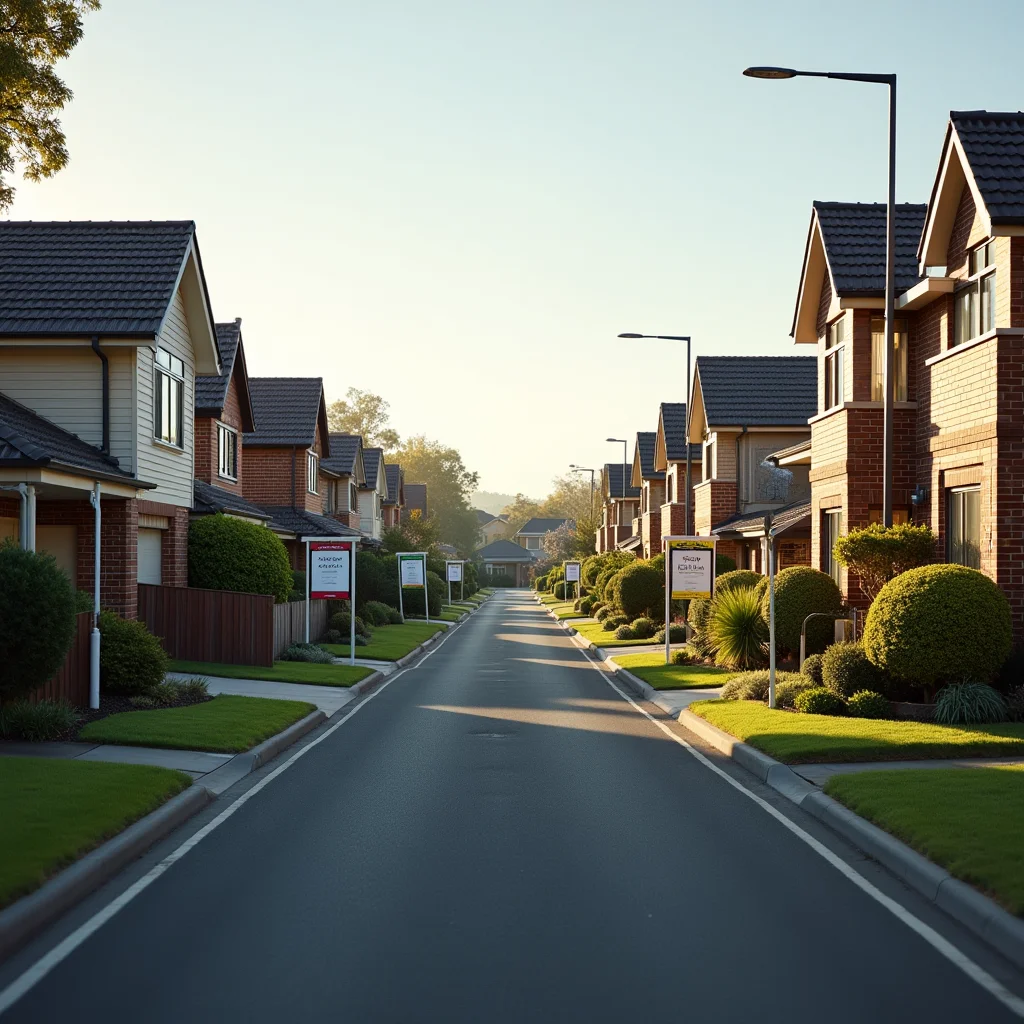
Cronulla recorded a 71.5% auction clearance rate at a $2,350,000 median price, with properties selling in 25 days and annual growth of 5.9% — performance metrics that place the southern Sydney suburb firmly in the upper tier of NSW prestige markets at a time when the national median has slid to $894,000 and Sydney's broader clearance rate has retreated sharply. Against a backdrop of the RBA's 4.35% cash rate compressing buyer capacity across most price segments, Cronulla's figures point to a buyer cohort that is largely insulated from mortgage stress and actively deploying capital into a supply-constrained coastal market.
Clearance Rate at 71.5% Positions Cronulla Among Sydney's Strongest Prestige Performers
A 71.5% auction clearance rate is a meaningful signal in the current rate environment. For context, Sydney's citywide clearance rate has retreated to 48% in recent weeks, and markets such as Port Macquarie are recording clearance rates as low as 46% with days on market stretching to 48. Cronulla's 71.5% figure places it alongside Randwick (73.5%) and Kirribilli (72.5%) as one of the few Sydney suburbs maintaining buyer competition at auction despite sustained rate pressure.
The 25-day sales cycle reinforces that reading. When properties sell in 25 days at a $2,350,000 median, it reflects genuine buyer depth — not just optimistic vendor pricing. By comparison, Ballina records a 45-day sales cycle at a $1,350,000 median, and Liverpool sits at 38 days at $850,000. The speed of Cronulla transactions relative to price point is a distinguishing marker of tier 1 prestige demand rather than affordability-driven volume activity.
Vendors in Cronulla who choose auction as their method of sale are being rewarded with competitive on-the-day outcomes. The auction method tends to extract price premiums when buyer competition is genuine, and a 71.5% clearance rate indicates that competition is present in meaningful volume. Agents campaigning in this suburb have statistical grounds to recommend auction over private treaty for correctly priced stock.
5.9% Annual Growth at $2.35 Million — How Cronulla Compares Across Prestige Tiers
Cronulla's 5.9% annual growth at a $2,350,000 median sits above the pace of several established prestige benchmarks. Toorak in Victoria — one of Australia's most recognised prestige addresses — recorded 4.5% annual growth at a $2,800,000 median. Kew recorded 4.4% growth at $2,100,000. Kirribilli, at $2,650,000, delivered 4.8% growth. Cronulla's 5.9% rate outperforms each of these comparators, which is a significant data point for investors evaluating relative value within the prestige tier.
What differentiates Cronulla from inner-metropolitan prestige markets is its coastal scarcity premium. The suburb's position on the Bate Bay waterfront creates a hard geographic constraint on supply that inland prestige suburbs do not share. That constraint supports price floors during soft markets and amplifies growth during periods of high demand. The 5.9% growth figure reflects both the structural scarcity of beachside landholdings and sustained demand from high-net-worth owner-occupiers who tend to transact on lifestyle rather than yield criteria.
Cronulla's 71.5% auction clearance rate, 25-day sales cycle, and 5.9% annual growth at a $2,350,000 median collectively position the suburb as one of Sydney's most data-confirmed prestige performers — outpacing Toorak's 4.5%, Kew's 4.4%, and Kirribilli's 4.8% annual growth rates in the current rate cycle.
It is worth comparing Cronulla's growth rate against Western Australia's prestige tier to calibrate expectations. Nedlands recorded 15% annual growth at a $2,200,000 median with a 15-day sales cycle — figures that reflect WA's exceptional macro tailwinds rather than a structural repricing of Sydney's relative value. Cronulla's 5.9% growth in a broadly softening NSW market is the more instructive benchmark for assessing the suburb's standalone resilience.
Rental Yield at 2.3% — The Investor Calculus in a Rate-Constrained Environment
Cronulla's 2.3% rental yield places it squarely within the low-yield profile typical of coastal prestige markets where capital growth rather than income is the primary return driver. At a $2,350,000 price point and a 4.35% RBA cash rate, the carrying cost of a leveraged position significantly exceeds rental income — a dynamic that effectively filters the buyer pool toward high-equity owner-occupiers and cash buyers rather than leveraged investors seeking yield coverage.
This filtering effect has implications for market stability. Owner-occupier-dominated markets at the prestige end tend to exhibit lower forced-sale risk during rate cycles because capital deployment decisions are not driven by serviceability ratios in the same way as investor-heavy suburbs. That structural characteristic partly explains why Cronulla's clearance rate has held at 71.5% while broader Sydney metrics have deteriorated. The buyers in this market are less sensitive to the RBA's 4.35% cash rate than borrowers in mid-tier or entry-level segments.
For investors who do hold Cronulla property, the land tax implications of a $2,350,000 asset base are material. As detailed by Australian Property Forum's analysis of land tax by state, NSW applies land tax on the unimproved land value above applicable thresholds, and high-value coastal landholdings can generate significant annual holding costs — a factor that sophisticated investors must model against the 2.3% gross yield when assessing total return. For macro and interest rate context framing holding cost decisions, macro and interest rate market analysis provides additional perspective on the RBA cycle trajectory.
Understanding the Prestige Market Cycle in Cronulla's Context
Prestige markets in Australia operate with a degree of lag relative to broader market cycles. When mass-market segments soften under rate pressure, prestige markets often maintain momentum for several additional months before responding — and when they do soften, the correction is typically shallower due to lower forced-sale volume. Cronulla's current metrics — 71.5% clearance, 25-day sales cycle, 5.9% growth — are consistent with a market that has not yet absorbed the full weight of the rate environment, but where underlying demand is genuine rather than speculative.
According to Property Cycle Timing — Using Data to Make Better Decisions, clearance rates and days on market function as leading indicators that can signal market shifts two to six months before price movements become visible in median data. Cronulla's 25-day sales cycle and 71.5% clearance rate are, by this framework, forward-looking signals of continued price support rather than confirmation of past growth alone. Agents and vendors should read these metrics as indicators of where pricing authority currently sits — with sellers — rather than as guarantees of continued acceleration.
The comparison with Sydney's eastern suburbs is instructive. Randwick recorded 73.5% clearance at a $2,400,000 median with a 23-day sales cycle — marginally faster and marginally higher clearance than Cronulla, but operating at a comparable prestige tier with similar buyer demographic profiles. Surry Hills at $1,920,000 recorded 73% clearance in 23 days. These comparable results across geographically distinct Sydney prestige precincts suggest the buyer cohort supporting these markets is broad-based rather than concentrated in a single corridor.
What the Data Signals for Agents, Buyers, and Vendors in Cronulla
For vendors, Cronulla's current metrics support a decisive approach to pricing and method of sale. A 71.5% clearance rate and 25-day sales cycle indicate that correctly priced stock is being absorbed quickly, which reduces the risk of prolonged campaign exposure that can erode price expectations. Vendors who understand the contract of sale process and engage agents experienced in the prestige auction format are best positioned to extract competitive on-the-day outcomes from the current buyer pool.
For buyers, the 5.9% annual growth trajectory and demonstrated demand depth suggest that waiting for a significant price correction in Cronulla carries meaningful opportunity cost. The suburb's structural scarcity — finite beachside landholdings, no meaningful new housing supply pipeline — means the forces that would produce a sustained price correction are largely absent. Buyers with capacity to transact now are operating in a market where vendor confidence is high and competition at auction remains present, making pre-auction negotiation increasingly difficult to execute successfully.
For agents operating in Cronulla, the 25-day average sales cycle creates a compressed campaign window that rewards preparation, database depth, and precise pricing guidance. Properties that linger beyond 35 days in a suburb averaging 25 days signal a pricing or presentation issue that is visible to buyers and risks compounding into a stale listing dynamic. The data supports proactive campaign review at the three-week mark rather than waiting for the market to provide a correction signal.

