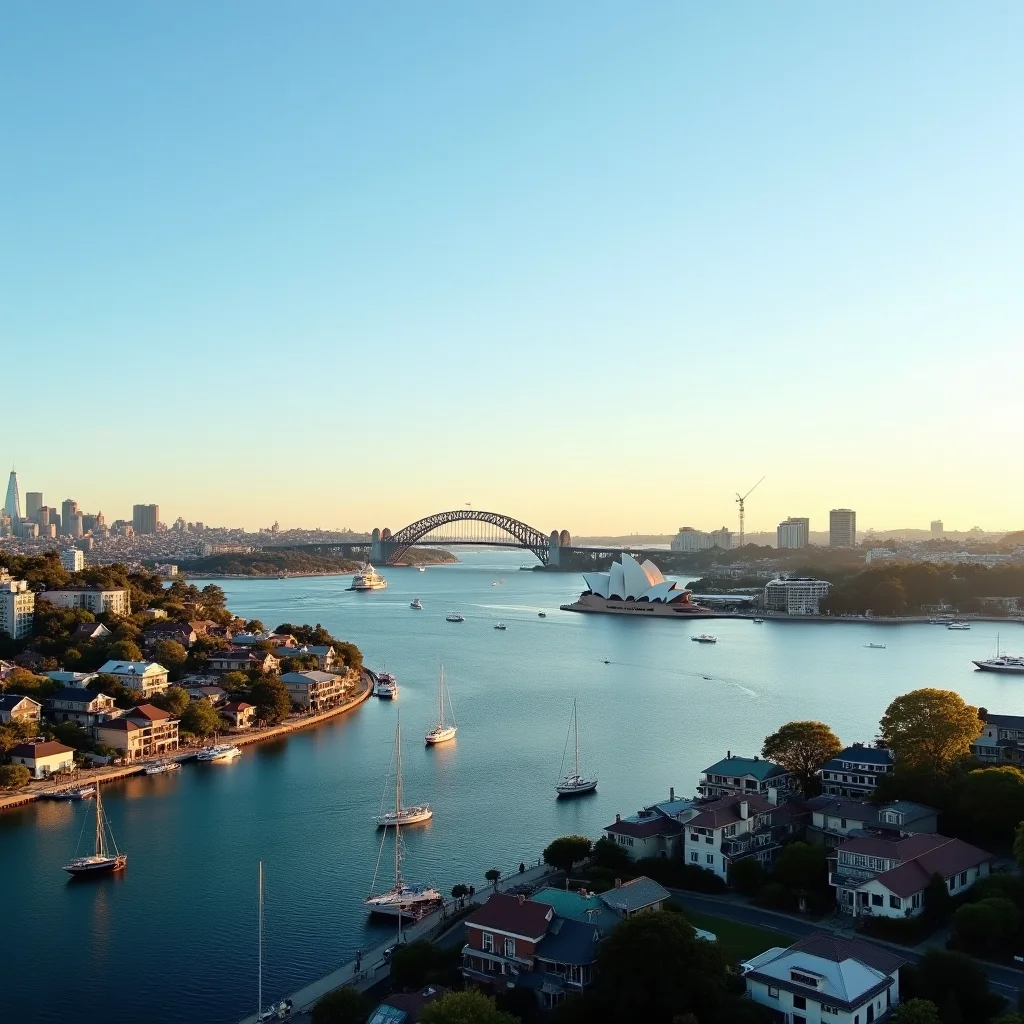
Double Bay's median house price sits at $3,500,000 with 7.8% annual growth, the strongest momentum reading among Sydney's twelve premier suburbs tracked across this comparison, while Annandale manages just 5.3% growth despite a comparatively modest $2,050,000 median. The split emerges as Victoria's new auction disclosure laws, detailed by REA Group on 13 October 2026, threaten to delay one in ten Melbourne auction campaigns — a disruption Sydney's prestige corridor has avoided. Twelve suburbs stretching from Double Bay to Surry Hills hold clearance rates between 73% and 78%, a band tight enough to signal demand concentration rather than broad market weakness.
The Clearance Rate Ladder: 78% Down to 73%
Ranked by clearance rate, the cohort reads Double Bay 78%, Manly 77%, Coogee 76%, Balmain 75.5%, Rozelle 75%, Newtown and Drummoyne tied at 74.5%, Bondi Beach 74.2%, Annandale and Neutral Bay tied at 74%, Randwick 73.5%, and Surry Hills 73%. The full spread across twelve suburbs is only five percentage points — a far tighter range than the volatility reported elsewhere in the Sydney market this spring.
That compression matters. A five-point band across a dozen suburbs with medians ranging from $1,920,000 to $3,500,000 indicates buyer demand is distributed evenly across the tier rather than concentrated in one or two standout postcodes. Agents operating in Surry Hills or Randwick are clearing at rates within striking distance of Double Bay, even though their entry price points sit $1.5 million to $1.6 million lower.
Sydney's twelve-suburb prestige cohort shows just a five-point clearance rate spread — from Double Bay's 78% to Surry Hills' 73% — despite a $1.58 million gap between their respective medians, pointing to demand depth across the tier rather than a single-suburb anomaly.
Growth Momentum Doesn't Track Price
Price and growth rate are decoupling inside this tier. Double Bay, the most expensive suburb on the list at $3.5 million, also posts the highest annual growth at 7.8%. But Drummoyne, priced at $2.35 million — roughly a third cheaper — grows at just 5.7%, and Surry Hills, the cheapest suburb in the comparison at $1.92 million, posts the lowest growth figure of the group at 5.5%.
Manly reinforces the pattern at the top end, recording $3.2 million medians against 7.2% growth, placing it second only to Double Bay on both metrics. Coogee follows at $2.8 million with 6.5% growth, while Bondi Beach — despite a $3.1 million median that outranks Coogee, Balmain, and Drummoyne on price — lags on clearance at 74.2% and growth at 6.1%. The data suggests buyers are paying premiums for specific locational attributes in Double Bay and Manly that aren't replicated simply by proximity to water or harbour frontage elsewhere in the cohort.
Days on Market: An 18-Day Cycle Against a 22-23 Day Norm
Double Bay's 18-day median sales cycle is the fastest in the group, followed by Manly at 19 days and Coogee at 20 days — matching Bondi Beach's 20-day figure despite Bondi's lower clearance rate. The remainder of the cohort clusters at 21 to 23 days: Balmain at 21, Rozelle and Neutral Bay at 22, and Newtown, Drummoyne, Annandale, Randwick, and Surry Hills all sitting at 22 to 23 days.
The four-to-five day gap between Double Bay and the slowest suburbs in the tier is modest by national standards, but within a $2 million-plus price bracket it reflects a measurable difference in buyer urgency. Vendors in Surry Hills and Randwick are still clearing above 73%, but campaigns run roughly a quarter longer than in Double Bay, giving agents a longer window to manage price expectations before settling on a result.
Background: Reading the Prestige Cycle Against Broader Demand Signals
This tier's resilience sits against a backdrop of retreating entry-level demand. REA Group reported on 13 October 2026 that first-home buyer loan demand has fallen for a third straight month, despite recent budget tax reforms designed to support that cohort. The contrast is instructive: while first-home buyers retreat from the market, the twelve-suburb prestige tier examined here holds clearance rates above 73% across the board, underscoring how unevenly current conditions are distributing across price segments — a dynamic explored further in Australian property market data covering buyer segmentation by price tier.
Timing decisions inside a tier this tight benefit from leading indicators rather than lagging price data alone. The principles behind reading clearance rate and days-on-market shifts ahead of price movements are detailed in Property Cycle Timing — Using Data to Make Better Decisions, which outlines how these signals typically move two to six months ahead of the broader cycle in Australia's seven-to-ten-year property pattern.
What This Signals for Agents and Vendors
Vendors in Double Bay and Manly retain genuine pricing power — fast cycles and above-75% clearance rates give agents room to hold firm on reserves. Further down the tier, in Surry Hills, Randwick, and Annandale, clearance rates in the 73-74% band remain solid by current market standards, but the additional four to five days on market and lower growth figures suggest buyers are negotiating harder before committing. Agencies managing campaigns across this price bracket should expect the spread between fastest and slowest suburbs to persist rather than close, particularly while entry-level buyer activity continues to soften and demand stays concentrated at the top of the market.