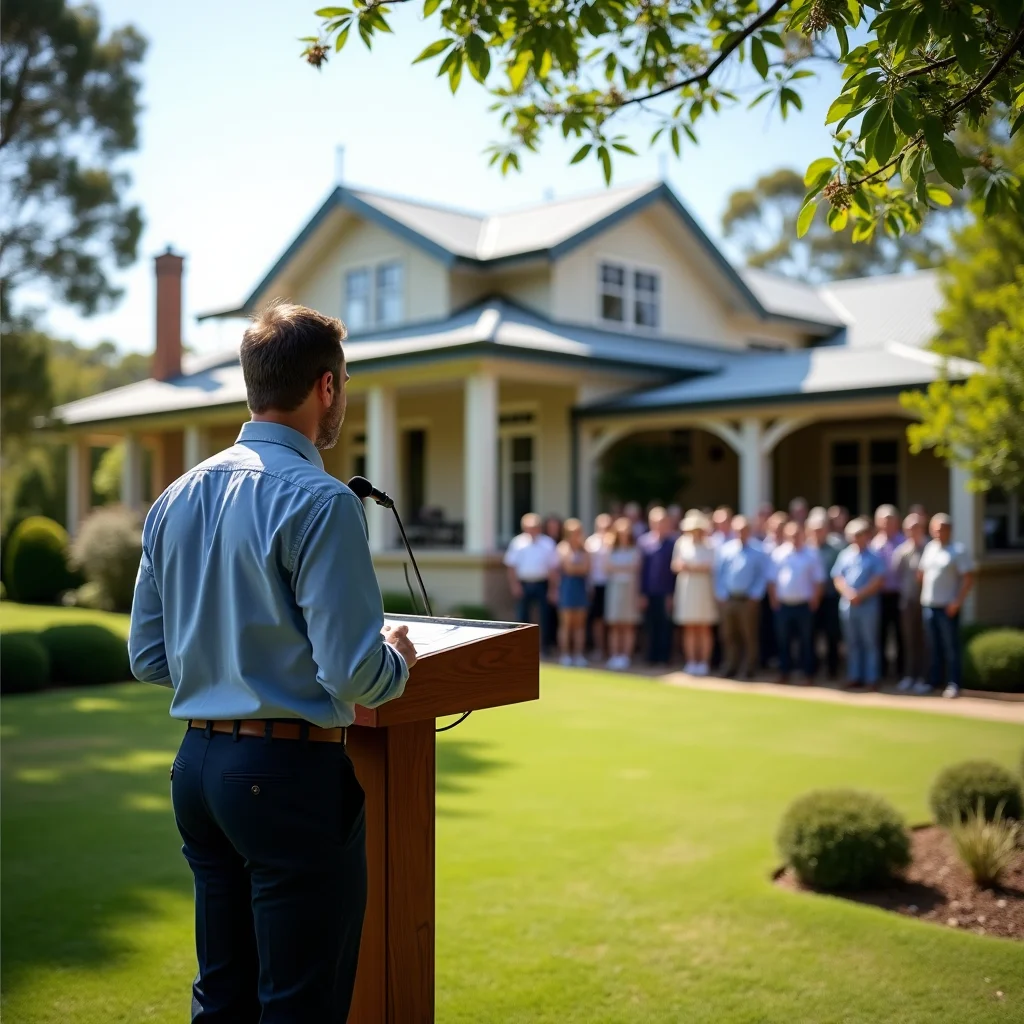
Hornsby recorded 4.5% annual growth at a $1,450,000 median price, with properties clearing in 29 days and a 67.5% auction clearance rate — figures that place the Upper North Shore suburb well above Sydney's broader auction market at a time when, according to REA Group, investors have largely abandoned the residential auction market across the city. While Sydney's aggregate clearance data has been depressed by investor withdrawal, Hornsby's owner-occupier base has insulated the suburb from the sharpest pressure, maintaining a clearance rate that sits 26 percentage points above Port Macquarie's 46% and competes directly with Queensland's strongest inner-city performers.
Hornsby's Clearance Rate in a Market Defined by Investor Retreat
The June 2026 auction environment across New South Wales has been defined by a structural shift in buyer composition. According to REA Group's 26 June 2026 report, investors have largely exited the residential auction market, leaving owner-occupiers as the dominant bidding cohort in suburbs where lifestyle credentials and school catchments drive purchasing decisions. Hornsby fits this profile precisely: its 67.5% clearance rate is not a product of speculative demand, but of sustained owner-occupier conviction in a suburb that offers train access to the Sydney CBD, proximity to Ku-ring-gai National Park, and strong secondary schooling options.
Comparing Hornsby's clearance rate against the broader NSW data set reveals the suburb's relative strength. Port Macquarie sits at 46% with a 48-day selling cycle — a 22-percentage-point gap and a 19-day difference in time on market. Randwick achieves a higher 73.5% clearance rate, but at a $2,400,000 median it serves a fundamentally different buyer demographic. At $1,450,000, Hornsby occupies the tier 2 price band where motivated owner-occupiers — including upsizing families and sea-changers returning from regional markets — can still compete without the full financial exposure of an inner-city prestige purchase.
The 29-day selling cycle is equally instructive. Properties sitting on market for under 30 days indicate genuine buyer depth, not vendor desperation pricing. At the RBA cash rate of 4.35%, serviceable loan sizes remain constrained, and a 29-day average implies buyers are arriving pre-approved and acting decisively — a behavioural pattern that agents in slower markets like Ballina (45 days) and Liverpool (38 days) are not currently observing.
The $1,450,000 Median: What the Price Point Reveals About Buyer Composition
Hornsby's $1,450,000 median places it at the lower boundary of Sydney's upper-middle tier — accessible to dual-income households with established equity positions, yet beyond the reach of most first-home buyers operating under current lending constraints. This price positioning creates a specific competitive dynamic: auctions draw a narrow but committed pool of buyers, which supports clearance rates without generating the bidder depth seen at Randwick or Kirribilli ($2,650,000 median, 72.5% clearance, 24 days on market).
The 4.5% annual growth figure reflects compounding demand against constrained supply. Hornsby's established streetscapes, heritage overlay precincts, and limited greenfield development capacity mean new stock enters the market slowly. Vendors who have held for five or more years are realising substantial nominal gains, and the absence of large-scale unit development pipelines comparable to inner-Sydney corridors means the suburb's median is not subject to the dilution effect that suppresses growth in high-density renewal areas.
For context, Toorak in Victoria records an identical 4.5% annual growth rate at a $2,800,000 median — demonstrating that this growth rate is achievable at multiple price points when supply is restricted and buyer quality is high. Hornsby's version of this dynamic plays out at a median nearly half Toorak's price, which broadens the accessible buyer base and sustains transaction volumes through interest rate cycles.
Hornsby's 67.5% auction clearance rate and 29-day selling cycle place it among Sydney's most consistent tier 2 performers in the June 2026 market — outpacing the NSW regional average by a substantial margin while maintaining a $1,450,000 median that owner-occupier demand continues to support.
Rental Yield and the Investor Calculation at 4.35%
Hornsby's 2.9% rental yield deserves direct examination against the RBA's current 4.35% cash rate. At face value, a yield of 2.9% against a borrowing cost of 4.35% produces negative cash flow — and this arithmetic explains, in part, why investor activity in the suburb and across the broader Sydney upper-middle market has softened. The REA Group report published 26 June 2026 specifically identifies investor withdrawal as a defining feature of the current national auction environment, and Hornsby's yield profile is consistent with that national pattern.
However, framing Hornsby purely through a yield lens misrepresents the investment case. The 4.5% annual capital growth delivered over recent years has generated total returns that significantly exceed the yield shortfall when calculated on a leveraged basis. An investor who purchased at a prior median and has experienced compounding growth will have seen their equity position strengthen materially, even as monthly cash flow remains negative. The suburb's position as a well-documented performer in Australian property market data supports the view that capital growth, not yield, is the primary return driver for Hornsby buyers.
Comparing Hornsby's 2.9% yield against Western Australian performers underscores the structural yield gap between east-coast lifestyle suburbs and high-growth regional markets. Mandurah records 10.5% annual growth at a $550,000 median with a yield profile that, at lower entry prices, produces more manageable cash flow shortfalls. Investors seeking yield-first strategies are evidently being drawn westward, which partly explains why the investor cohort has thinned at Hornsby auctions — but this same dynamic reinforces the owner-occupier dominance that sustains the suburb's clearance rate.
Hornsby as a 2027 Hotspot: What the Forward Indicators Show
According to Property Update's 26 June 2026 market analysis, the key developments shaping 2027 property hotspots include the SMSF lending ban and broader macro shifts that are redirecting capital toward owner-occupier-dominant suburbs with strong infrastructure fundamentals. Hornsby's profile aligns with several of the forward indicators Property Update identifies as markers of sustained demand: transport connectivity, school catchment strength, and constrained housing supply.
The suburb's days-on-market figure of 29 days is a leading indicator worth tracking. When this number begins to compress toward the low-20s — as seen in West End QLD (22 days) and Toorak VIC (23 days) — it typically precedes accelerating price growth as buyer competition intensifies against finite stock. Conversely, if days on market extends toward 35–38 days, it signals buyer hesitation and can precede price softening. At 29 days, Hornsby sits in a neutral-to-positive position that provides vendors with reasonable confidence in campaign outcomes while not yet signalling the kind of extreme tightness that produces premium auction results.
Buyers considering Hornsby for a 2027 acquisition horizon should weigh the suburb's demonstrated resilience against the likelihood of further rate adjustments. Understanding the full purchase process — including the implications of the contract of sale and cooling-off rights under NSW law — is material to campaign strategy in a market where 67.5% of auctions clear, meaning roughly one in three properties passes in and enters post-auction negotiation. For buyers who find the auction environment challenging, working with a professional is one option worth evaluating — the REAStats guide to what a buyer's agent is and whether you need one covers how this arrangement operates in competitive NSW markets.
Tier 2 Lifestyle Suburb Positioning: Hornsby Against the NSW Comparison Set
Classifying Hornsby as a tier 2 lifestyle suburb reflects its combination of: a median price above the Sydney metropolitan average but below the prestige threshold; auction clearance rates above 65% indicating genuine vendor market conditions; days on market below 35 days; and annual growth between 4–6% that tracks above inflation without the volatility of speculative growth corridors. Against this definition, Hornsby compares favourably with Surry Hills ($1,920,000 median, 5.5% growth, 23 days, 73% clearance) at a significantly lower price point, and outperforms Liverpool ($850,000 median, 3.5% growth, 38 days, 60.5% clearance) on every performance metric except affordability.
The tier 2 classification also implies a specific vendor strategy consideration. At this price point and clearance rate, auction remains the optimal campaign method for most properties — the 67.5% clearance rate indicates that conditional buyers are being converted to unconditional purchasers at auction at a higher rate than the Sydney aggregate. Vendors who default to private treaty at this price point risk leaving competitive tension on the table, particularly for family homes in strong school catchments where two or more pre-qualified buyers are often tracking the same property simultaneously.
For macro context on how interest rate settings are influencing buyer behaviour across this tier, the macro and interest rate market analysis published on WealthWatchPro provides a detailed breakdown of how the 4.35% cash rate is affecting serviceability thresholds at different loan sizes — directly relevant to Hornsby buyers entering the $1,200,000–$1,600,000 purchase range.
Hornsby's current data profile — $1,450,000 median, 4.5% annual growth, 67.5% clearance, 29 days on market, 2.9% yield — presents a coherent picture for agents, buyers, and vendors operating in the suburb over the next two quarters. Vendors holding well-presented family homes in established streets can expect competitive auction fields from owner-occupier buyers, provided marketing campaigns are appropriately calibrated to the price guide. Buyers face a market with genuine competition but not the extreme scarcity of WA's 15-day cycles, making due diligence timelines achievable. Investors must price in negative cash flow against capital growth expectations and accept that the 2.9% yield does not cover debt service at current rates — the investment thesis rests on sustained price appreciation in a supply-constrained, infrastructure-connected suburb.

