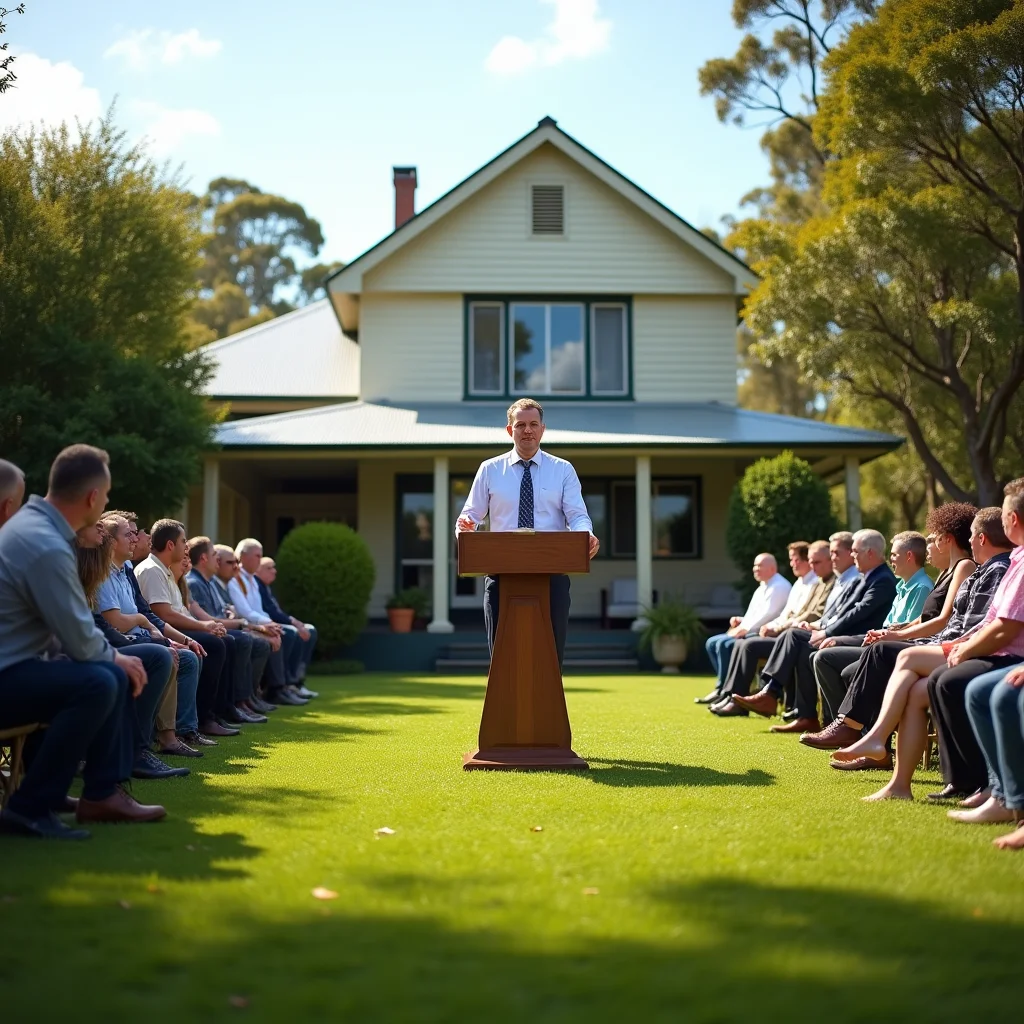
Karrinyup recorded 13.5% annual growth to a $1,250,000 median in the current cycle, with properties clearing in 19 days on market and an auction clearance rate of 61.5% — metrics that place this northern Perth prestige suburb comfortably ahead of most comparable eastern seaboard markets at the RBA's 4.35% cash rate. While REA Group reported on 27 June 2026 that Melbourne's auction market remains frozen and property professionals are eyeing a potential Liberal election victory as a circuit-breaker, Karrinyup's data signals no such distress — structural demand from owner-occupiers and prestige buyers continues to absorb available stock at pace.
Karrinyup's Prestige Credentials: $1,250,000 Median in Context
At a $1,250,000 median, Karrinyup sits firmly in Western Australia's tier 1 prestige bracket, occupying territory above Fremantle's $950,000 median and approaching — though not yet matching — South Perth's $1,450,000 median and Nedlands' $2,200,000 ceiling. The 13.5% annual growth figure is particularly significant when measured against comparable prestige markets on the eastern seaboard: Toorak in Victoria recorded 4.5% growth to a $2,800,000 median, while Sydney's Randwick reached 5.6% annual growth at a $2,400,000 median. Karrinyup's growth rate is more than double either of those results, achieved at a substantially lower entry price point — a combination that has attracted both interstate buyers and local upgraders seeking value within the prestige tier.
The suburb's position within the broader Perth prestige corridor is reinforced by its coastal proximity, established school catchments, and proximity to the Karrinyup Shopping Centre precinct. These fundamentals have consistently underpinned buyer demand even as rate conditions tightened through 2024 and into 2026. At 13.5% annual growth, a buyer who purchased at the 2025 median has generated approximately $168,750 in nominal capital gain within 12 months — a figure consistent with the broader WA premium suburb outperformance documented nationally.
19-Day Sales Cycle Signals Tight Supply and Decisive Buyers
Karrinyup's 19-day median days on market is one of the most telling indicators of prestige demand intensity in the current cycle. Across the national data set, this figure compares favourably with South Perth at 17 days and Nedlands at 15 days — both of which represent WA's fastest-moving prestige markets — while sitting well below eastern seaboard comparables such as Toorak at 23 days, Kew at 24 days, and Randwick at 23 days. The gap widens considerably against struggling regional and outer-metropolitan markets: Port Macquarie sits at 48 days, Ballina at 45 days, and Dandenong at 40 days.
A 19-day sales cycle at the $1,250,000 price point reflects buyers who have completed due diligence before entering the market, are pre-approved at current lending rates, and are prepared to act without extended negotiation periods. In a rate environment where serviceability buffers compress buyer pools, this decisiveness is a material signal. Vendors in Karrinyup can reasonably expect campaigns to resolve within three weeks when properties are priced accurately against recent comparable sales — making precise initial pricing strategy more important than in slower-moving markets where extended campaigns allow for price discovery over time. For a detailed framework on how agents and vendors should approach this, Understanding Comparable Sales outlines the methodology behind competitive pricing in active prestige markets.
Karrinyup's 19-day median days on market at a $1,250,000 median places it among WA's fastest-clearing prestige suburbs — 29 days faster than Port Macquarie and 4 days faster than Toorak, reflecting concentrated demand and a buyer pool that is both qualified and prepared to transact at pace.
61.5% Clearance Rate: Reading the Auction Signal in a Private Treaty Market
Karrinyup's 61.5% auction clearance rate requires careful interpretation. Western Australia has historically operated as a predominantly private treaty market, and Perth prestige suburbs do not generate the auction volumes seen in Melbourne or Sydney inner suburbs. The 61.5% figure therefore reflects a selective auction program where vendors and agents have chosen the method deliberately — typically for properties with strong comparable sales support and a competitive buyer pool. A clearance rate above 60% in this context is a healthy result, indicating that the auction method is being deployed appropriately rather than as a default.
By comparison, Melbourne's auction market is under significant structural pressure. According to Australian Property Forum, Melbourne's clearance rate has deteriorated to the point where property professionals are publicly discussing a potential Liberal election victory under Jess Wilson as a catalyst for sentiment recovery. Toorak — Melbourne's premier prestige suburb — recorded a 72% clearance rate, but that result comes against a backdrop of reduced listing volumes and selective vendor participation rather than broad market confidence. Karrinyup's 61.5% is generated in a fundamentally different demand environment, where buyers are not waiting for political signals to act.
The contrast with eastern states also extends to the Australian Property Forum's reporting on Cotality's Q1 2026 Pain & Gain data, which found 96.0% of Australian residential resales turned a profit in Q1 2026 with a record median nominal gain of $377,000. WA's outperformance relative to national averages is embedded in that figure — and Karrinyup's growth trajectory has contributed to that state-level result.
2.8% Rental Yield and the Prestige Investor Calculation
Karrinyup's rental yield of 2.8% is characteristic of a suburb where capital growth has outpaced rental growth — a common dynamic in prestige markets experiencing rapid price appreciation. At a $1,250,000 median, a 2.8% gross yield generates approximately $35,000 in annual rental income before costs, management fees, and vacancy. Against the RBA's current 4.35% cash rate, this produces a negative carry position for leveraged investors: a standard 80% LVR investment loan at prevailing rates generates interest costs of roughly $43,500 annually on a $1,000,000 debt, before accounting for rates, insurance, maintenance, and management fees.
This yield-to-rate differential means Karrinyup is not primarily an investor-driven market at current entry prices. The demand underpinning the 13.5% growth figure is concentrated among owner-occupiers — upgraders, prestige buyers relocating within Perth, and interstate migrants drawn to WA's relative affordability at the prestige tier compared with Sydney and Melbourne equivalents. This is a structurally different buyer composition from suburbs where investor demand drives clearance rates and listing volumes, and it produces a more stable price floor: owner-occupier markets do not liquidate in response to yield compression the way investor-heavy markets can. For those assessing Australian property market data across prestige tiers, the owner-occupier concentration in WA prestige suburbs is a distinguishing characteristic that differentiates Perth's cycle from the eastern capitals.
WA Prestige vs Eastern States: The State-Level Performance Gap
Karrinyup's 13.5% annual growth sits within a broader WA prestige outperformance story that is now well-documented across multiple data sources. Nedlands leads WA prestige growth at 15% annually to a $2,200,000 median, while South Perth recorded 13.8% to $1,450,000. Karrinyup's 13.5% places it in direct competition with these established prestige corridors, offering a lower entry price than South Perth at comparable growth rates — a value proposition that has not gone unnoticed by buyers who track Perth's northern beach corridor.
Eastern states prestige markets are operating in a fundamentally different cycle. Victoria's top-end suburbs — Toorak at 4.5%, Kew at 4.4%, Prahran at 3.9% — are producing single-digit growth against higher median prices and a deteriorating auction environment. In New South Wales, Randwick's 5.6% and Kirribilli's 4.8% represent solid results relative to the broader Sydney market, but fall well short of WA's growth rates. Queensland's prestige-adjacent suburbs — West End at 8.8%, Indooroopilly at 8.5% — offer a middle ground, with stronger growth than the southern capitals but still trailing WA's leading suburbs by 5 percentage points or more.
The practical implication for agents operating in Karrinyup is that vendor expectations are anchored to continued growth, and buyer urgency is genuine rather than manufactured. Campaigns that are correctly priced against recent comparables and professionally presented are resolving within the 19-day median — leaving little room for extended negotiation or vendor discounting. Agents who understand the suburb's tier 1 prestige positioning relative to WA and national benchmarks are best placed to advise vendors on optimal pricing strategy and campaign method in the current cycle. The cooling-off period rules that apply in WA are also worth reviewing for buyers acting quickly in a fast-clearing market, as the state's framework differs from eastern states in ways that affect contract execution timelines.

