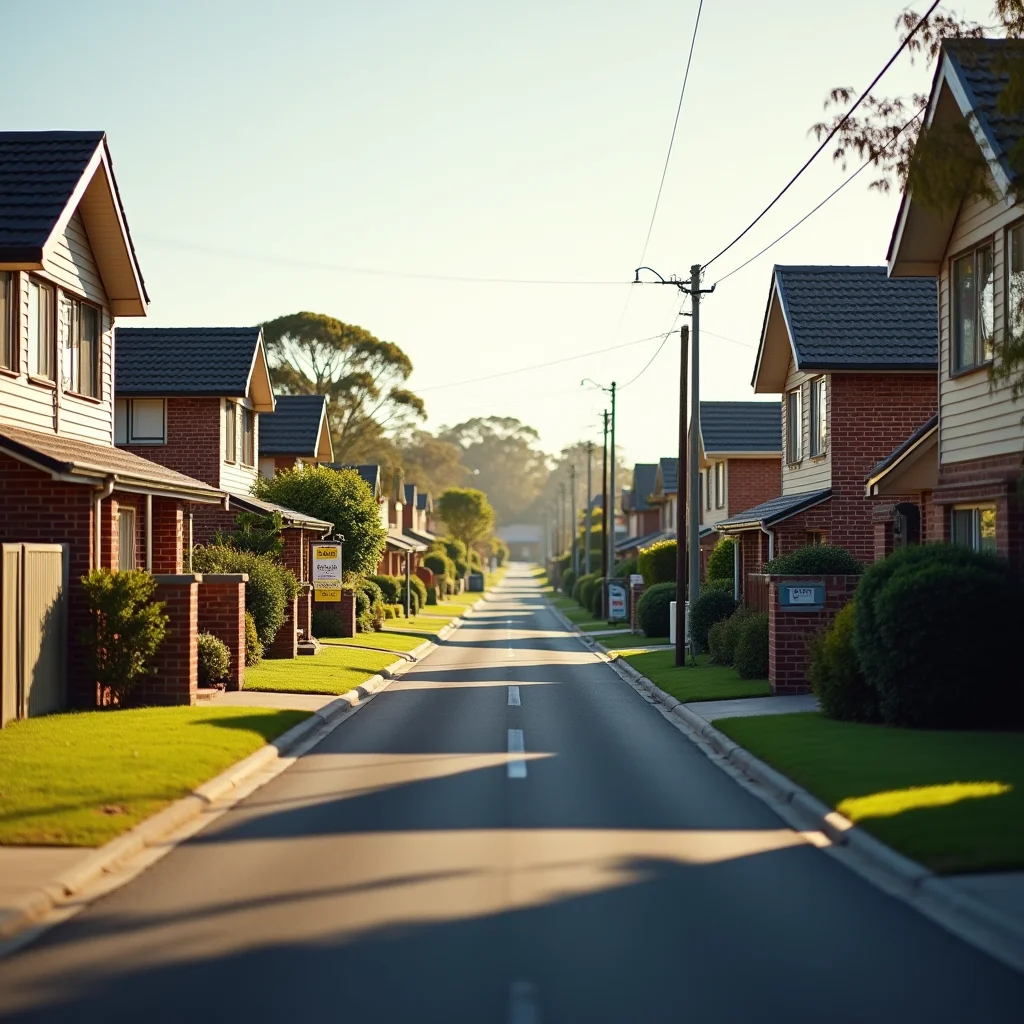
A Sydney vendor crystallised a $345,000 loss last weekend when a grand family home that sold for $4.7 million in 2025 changed hands again for $4,355,000, according to SMH Property — a result that encapsulates Sydney's deteriorating auction conditions. At the same moment, Nedlands in Western Australia was recording 15% annual price growth at a $2,200,000 median with properties clearing in just 15 days, while a Greater Brisbane mansion smashed its suburb record at $3.52 million. The RBA's cash rate, held at 4.35%, is not producing one national market — it is producing five distinctly different ones.
Sydney's Auction Market Under Sustained Pressure
The $345,000 loss reported by SMH Property is not an isolated outcome. Randwick, one of Sydney's stronger-performing eastern suburbs, holds a 73.5% auction clearance rate at a $2,400,000 median with 23 days on market — a pocket of resilience. But further west, Liverpool sits at a 60.5% clearance rate with 38 days on market at an $850,000 median, and Port Macquarie — while technically a regional NSW market — records just 46% clearance with 48 days on market at $850,000. Ballina tells a similar story: 47% clearance, 45 days on market, $1,350,000 median. The pattern across NSW outside the premium eastern suburbs is one of extended selling campaigns, vendor price concessions, and buyers holding negotiating power they have not held since 2019.
Penrith posts a 62% clearance rate at $880,000 with 35 days on market — marginally better, but still indicating buyer hesitancy at the affordable end of Sydney's outer ring. Kirribilli, by contrast, clears at 72.5% with just 24 days on market at a $2,650,000 median, and Surry Hills holds 73% clearance at $1,920,000. The data confirms a two-speed dynamic within NSW itself: prestige inner-city stock continues to attract competitive bidding, while mid-market and regional vendors face a buyer pool thinned by serviceability constraints at the current cash rate. For a deeper look at how clearance rates function as a market health signal, see the Auction Clearance Rates Explained guide.
Victoria: Prestige Pockets Hold, Broad Market Softens
Melbourne's market is splitting along similar lines. SMH Property reported on 3 August that a renovated Carlton North two-bedroom terrace attracted zero bids at auction and is now listed at $1.75 million through private treaty. That outcome sits alongside Toorak's 72% clearance rate at a $2,800,000 median with 23 days on market, and Kew's 71% clearance at $2,100,000 with 24 days on market. Prahran clears at 69% with 25 days on market at $1,550,000 — also showing relative strength.
The contrast sharpens at the lower end. Dandenong records just a 2.3% annual growth rate at a $680,000 median with 40 days on market and a 56% clearance rate. Reservoir sits at 2.8% annual growth, $880,000 median, 32 days on market, and 62% clearance. Newtown (VIC) posts 3.8% annual growth with a 52% clearance rate and 35 days on market. The Carlton North pass-in is a symptom of the broader mid-tier Victorian softening — buyers at the $1.5–$2 million price point are increasingly price-sensitive, and auction is no longer the automatic method of choice in those segments. Meanwhile, REA Group reported that an East Melbourne apartment held by one family for over 55 years exceeded auction expectations — reinforcing that scarcity and prestige remain auction-compatible, even in a softening Victorian market.
Nedlands (WA) records 15% annual growth at a $2,200,000 median and a 15-day sales cycle — a 33-day faster clearance than Port Macquarie's 48-day campaign and a growth rate more than four times Victoria's Dandenong at 2.3%.
Western Australia: The Nation's Strongest Capital Growth Corridor
Western Australia continues to post the most compelling growth figures of any state in the current data set. Nedlands leads at 15% annual growth with a 15-day sales cycle and 65.5% clearance rate — figures that reflect a fundamentally undersupplied market with deep buyer demand. South Perth records 13.8% annual growth at a $1,450,000 median and a 17-day sales cycle with 63.5% clearance. Mandurah adds 10.5% annual growth at $550,000 with 24 days on market, demonstrating that WA's outperformance extends well beyond prestige price points into affordable family-home territory.
Fremantle posts 5.8% annual growth at $950,000 with 25 days on market and 54.6% clearance — the weakest WA clearance rate in the data set, but still faster to sell than most NSW regional markets. The WA story is one of genuine supply-demand imbalance. Interstate migration, infrastructure investment, and a resources sector employment base have sustained buyer depth that other states cannot currently match. For macro and interest rate market analysis contextualising WA's relative insulation from rate headwinds, the state's economic diversification relative to Victoria and NSW is a central factor. The gap between Nedlands at 15 days on market and Port Macquarie at 48 days is not a seasonal aberration — it reflects structurally different demand pools at the 4.35% cash rate.
Queensland: Record Auction Results Alongside Moderate Clearance Rates
SMH Property reported on 3 August that a Greater Brisbane mansion described as a 'Taj Mahal' — complete with pillars, chandeliers, a pool, spa and golf putting green — smashed its suburb record at $3.52 million. That result reflects genuine prestige demand in Queensland's southeast, but the broader clearance data is more measured. West End posts 62% clearance at a $1,350,000 median with 22 days on market and 8.8% annual growth. Indooroopilly sits at 62.5% clearance, $1,380,000 median, 23 days on market, and 8.5% annual growth. Maroochydore records 54% clearance at $1,050,000 with 28 days on market and 8.5% annual growth.
Queensland's clearance rates trail Western Australia's premium suburbs by roughly 10 percentage points, but the state's annual growth rates are running at more than double Victoria's mid-market performance. Days on market across QLD suburban markets are clustering between 22 and 28 days — significantly faster than NSW regional equivalents. The Brisbane prestige segment's record results signal that high-net-worth buyer activity remains concentrated in showcase properties, while the broader southeast Queensland market attracts buyers priced out of Sydney and Melbourne who are still in accumulation mode. Rental Vacancy Rates Explained provides context on why this buyer migration is also compressing Queensland's rental market and influencing yield calculations for investors considering the state.
What the State Divergence Signals for Agents, Vendors, and Buyers
South Australia's market warrants brief mention as a supporting data point: Australian Property Forum reported on 3 August that South Australia has released residential lots from $250,000 exclusively for first-home buyers — a policy response to sustained price pressure in a market where national home values fell 0.7% in July 2026. That intervention signals state government recognition that organic affordability correction is not occurring fast enough to maintain entry-level access.
The aggregate picture across all five states is unambiguous: the RBA's 4.35% cash rate is not producing uniform price correction. It is accelerating divergence. WA's fastest-growing suburbs are clearing in under three weeks. Sydney's mid-market is posting capital losses. Victoria's broad middle is stalling at sub-3% annual growth while its prestige tier holds auction clearances above 70%. Queensland is growing at 8–9% annually with moderate clearance rates suggesting buyer competition remains real but not frenzied. For vendors, the state and suburb selection of campaign strategy now carries greater return implications than at any point in the past decade. For buyers, markets where days on market exceed 40 days — Port Macquarie at 48, Ballina at 45, Dandenong at 40 — represent genuine negotiating opportunities that WA and inner-Brisbane buyers simply do not have. Agents operating across state borders need to calibrate pricing advice and campaign duration to the specific market conditions measured by clearance rates and days on market, not national averages that obscure the full extent of this geographic fracture.

