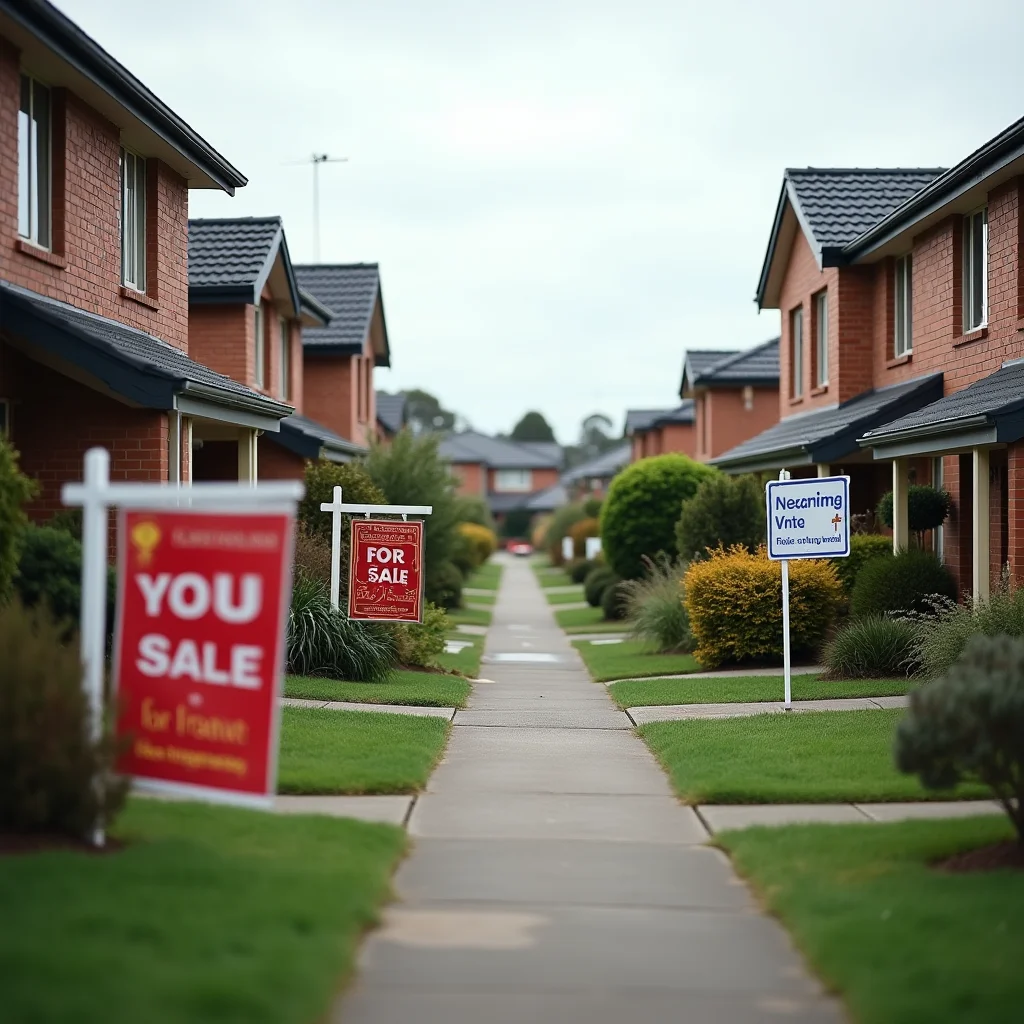
According to SMH Property, three earlier RBA interest rate rises — compounded by global economic uncertainty — have left household finances under sustained pressure in 2026, with families requiring substantial income growth just to maintain their relative position in the property market. The RBA cash rate has held at 4.35% for a second consecutive meeting, but the cumulative weight of prior hikes continues to suppress buyer demand across Sydney, Melbourne, and regional NSW. Meanwhile, REA Group published analysis on 12 August 2026 identifying 20 affordable Victorian and Tasmanian suburbs as potential price boom candidates — a direct consequence of rate-squeezed buyers retreating from premium markets toward lower entry-point suburbs.
The Cumulative Rate Burden: What 4.35% Actually Costs Buyers
The RBA's decision to hold the cash rate at 4.35% for a second straight meeting masks a more damaging reality: the three rate rises that preceded the current pause have already repriced mortgage serviceability across the country. According to SMH Property's 11 August 2026 analysis, households needed meaningful pay rises this year simply to stay competitive in the property market — not to improve their position, but to avoid falling behind. That distinction is critical for understanding current buyer behaviour.
The demand fracture shows clearly in days-on-market and clearance rate data. Port Macquarie in NSW sits at 48 days on market with an auction clearance rate of just 46%, and Ballina records 45 days on market at a 47% clearance rate — two coastal NSW markets where mortgage serviceability stress has effectively removed the buyer cohort that drove the 2021–2023 price surge. Liverpool in Sydney's south-west records 38 days on market with a clearance rate of 60.5% at an $850,000 median, reflecting the particular pressure on outer-ring suburbs where variable-rate mortgage holders are concentrated. By contrast, Dandenong in Victoria — with a $680,000 median and 2.3% annual growth — sits at 40 days on market, signalling that rate pressure has hollowed out demand at the affordable end of the Melbourne market.
REA Group's 20-Suburb Signal: Where Rate-Displaced Buyers Are Heading
REA Group's 12 August 2026 report on cheap Victorian and Tasmanian suburbs represents a structural demand shift rather than speculative optimism. As rate pressure pushes buyers out of mid-tier metropolitan markets, affordable suburbs with strong rental yield fundamentals and lower debt servicing requirements become the logical alternative. The analysis from Australian Property Forum reinforces this, identifying these 20 suburbs as entry-point opportunities for buyers and investors willing to move before the broader market recognises the value.
The mechanism is straightforward: a buyer who cannot service a $1,550,000 mortgage in Prahran — where the median sits at that level with 3.9% annual growth and a 69% clearance rate — can potentially service a significantly smaller loan in a regional Victorian or Tasmanian suburb with a lower median. REA Group's identification of 20 such locations suggests the platform's search and inquiry data is already reflecting this migration of buyer intent. Prahran's 25 days on market and Kew's 24 days on market — versus 40 days in Dandenong — further illustrate how buyer depth has become uneven even within the same state.
Port Macquarie's 46% auction clearance rate and 48-day sales cycle versus Randwick's 73.5% clearance rate at 23 days on market — within the same state — quantifies how three RBA rate hikes have created a two-speed NSW market split entirely along affordability lines.
Western Australia's Rate Immunity: A Structural Contrast
The most striking counterpoint to the rate-driven demand suppression in NSW and Victoria is Western Australia's performance. Nedlands records 15 days on market, a 65.5% clearance rate, and 15% annual growth at a $2,200,000 median — outperforming every comparable eastern-seaboard suburb in this dataset on velocity metrics. South Perth records 13.8% annual growth at a $1,450,000 median with just 17 days on market. Mandurah sits at 10.5% annual growth with a $550,000 median and 24 days on market, offering a rate-serviceable entry point that eastern-seaboard equivalents cannot match at current borrowing costs.
WA's relative insulation from RBA rate impact traces to two factors: a lower median price base relative to income levels compared to Sydney and Melbourne, and a sustained interstate migration inflow from Queensland and New South Wales that has maintained buyer depth even as rate costs rise. For macro and interest rate market analysis, the WA divergence is the clearest signal that demand destruction from rate policy is not uniform — it concentrates where debt-to-income ratios are highest relative to local wages.
Fremantle at 5.8% annual growth with a $950,000 median and 25 days on market further illustrates WA's mid-tier resilience. That figure compares directly with Liverpool's 3.5% growth at the same $850,000 median but 38 days on market — a 13-day difference in sales velocity that reflects WA's structural demand advantage under current rate conditions.
Queensland as the Demand Safety Valve
Queensland continues to absorb rate-displaced buyer demand from southern states. West End records 8.8% annual growth at a $1,350,000 median with just 22 days on market and a 62% clearance rate. Indooroopilly posts 8.5% growth at $1,380,000 with 23 days on market, and Maroochydore on the Sunshine Coast records 8.5% annual growth at a $1,050,000 median — a price point still serviceable for dual-income households managing 4.35% variable rates.
The Queensland figures matter specifically in the context of the SMH's rate burden analysis. A $1,050,000 property in Maroochydore carries meaningfully lower monthly repayments than a comparable lifestyle property in coastal NSW — Ballina sits at $1,350,000 with 4% annual growth but 45 days on market and a 47% clearance rate. That $300,000 price differential represents roughly $1,800 per month in mortgage repayments at current rates, which is precisely the kind of affordability gap that drives interstate buyer migration and explains why Queensland's growth rate metrics are outperforming NSW equivalents in this data cycle. For those assessing rental vacancy rates alongside these price trends, Queensland's low vacancy environment adds further yield support to the capital growth story.
What Rate Pressure Means for Prestige Markets and Vendor Strategy
Prestige suburbs have demonstrated a more complex response to the 4.35% rate environment than the headline demand suppression narrative suggests. Toorak holds a 72% auction clearance rate at a $2,800,000 median with 23 days on market — outperforming Dandenong's 56% clearance despite sitting at four times the price. Randwick clears 73.5% of auctions at a $2,400,000 median in 23 days. Kirribilli records 72.5% at $2,650,000 in 24 days. The pattern is consistent: prestige buyers are predominantly equity-funded or cash-backed, meaning rate rises have less direct impact on their purchasing capacity.
The policy context adds further complexity. For investors assessing tax-efficient structures under the current rate environment, the mechanics of negative gearing in Australia remain relevant — particularly in higher-value markets where rental income falls well short of mortgage costs but capital growth has historically compensated. However, SMH's analysis that even holding current positions required significant income growth in 2026 suggests that the tax offset from negative gearing is providing diminishing comfort to leveraged investors in mid-tier markets where capital growth has slowed to 2–4% annually.
For vendors in rate-sensitive suburbs — particularly those in outer-ring NSW and lower-growth Victorian markets — the data points to a clear near-term reality: buyer pools are thinner, clearance rates are lower, and days on market are extending. Pricing strategy must account for a buyer cohort that has been stress-tested by three rate rises and is now operating at the ceiling of their serviceability. REA Group's identification of cheap Victorian and Tasmanian suburbs as price boom candidates is, in this context, as much a buyer demand story as a growth signal — it reflects where rate-constrained buyers can actually transact, not simply where agents want to sell.

