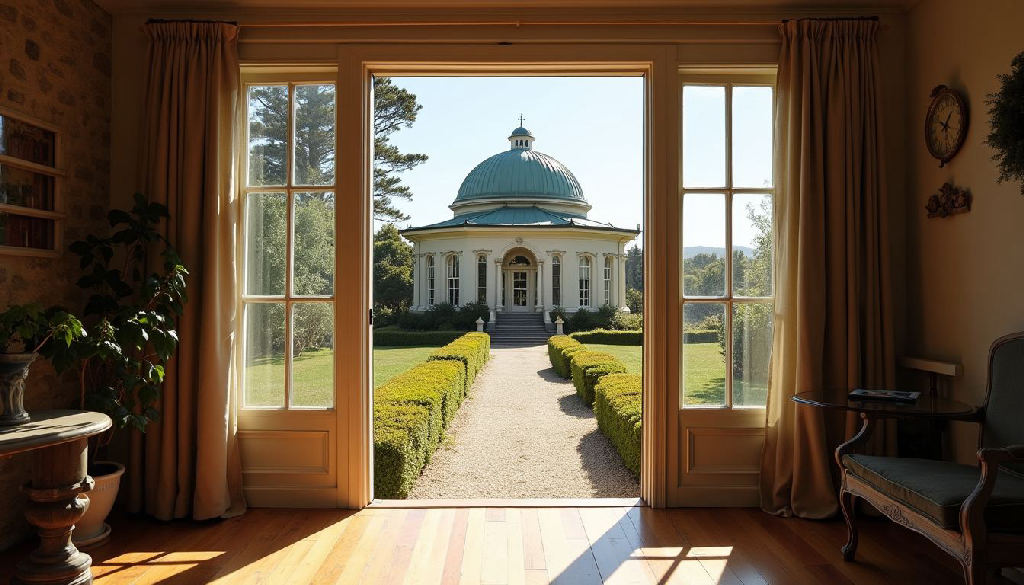
Bentley, a seven-bedroom colonial homestead on 56 acres at Chudleigh in northern Tasmania, listed with a $7.5 million–$8.5 million price guide, and selling agent Dominic Romeo of Dominic Romeo Historic Property says he has been "flat out with genuine enquiries" in the week since it hit the market. According to realestate.com.au, the bulk of that interest is coming from mainland buyers — some chasing a permanent family home in Tasmania, others wanting a weekender before relocating south. The 913sqm property, built in 1879 by federal parliamentarian Donald Norman Cameron, is being offloaded by the Cameron family, who bought it in 2020 purely for the surrounding farmland.
A Heritage Listing That Outpaces Its Own Backstory
The sale itself is an unusual case study in vendor motivation. Max Cameron, who owns the neighbouring Wesley Dale sheep operation, bought Bentley in 2020 with his four children in mind, all of whom are focused on agriculture and agritourism. As Cameron told realestate.com.au, "a lot of people would have bought it for the house and tolerated the farmland, but for us we bought it for the farmland and tolerated the house." That disconnect between land value and architectural value is now playing out in the listing strategy, with Dominic Romeo marketing the 913sqm homestead, outbuildings and surplus 56 acres as a standalone heritage asset separate from the working farm that originally justified its purchase.
For broader market context, see World Property Forum international property intelligence.
Romeo's observation that heritage purists have been "particularly excited" by the property points to a buyer segment that behaves differently from mainstream capital city purchasers. These buyers are drawn to the 10.6m x 10m conservatory beneath a Regency dome inspired by Brighton's Royal Pavilion, the marble fireplaces and huon pine cabinetry, and the 700m dry stone wall — details that don't factor into standard suburb comparables but drive premium pricing in a category where REAStats does not publish median figures because transaction volume is too thin to generalise.
Benchmarking Against the National Market
Bentley's $7.5m–$8.5m guide sits well outside the scale of ordinary residential transactions. REAStats records a national median dwelling price of $818,000, meaning Bentley's indicative value is close to nine times the typical Australian home. The national auction clearance rate stood at 68.8% as of October 19, 2026, with Sydney at 70.8%, Melbourne at 68.8% and Brisbane at 67.2% — figures that describe a fast-moving, broker-driven process entirely unlike the private-treaty, enquiry-based campaign Romeo is running for a one-off heritage asset.
REAStats puts the national median dwelling price at $818,000 against a 68.8% national auction clearance rate, underscoring how far outside standard market mechanics a $7.5m–$8.5m heritage estate like Bentley sits — these properties are sold on enquiry depth, not auction competition.
Even Australia's most expensive suburb markets fall short of Bentley's guide. Toorak carries a $2,800,000 median with 4.5% annual growth and a 72% auction clearance rate, while Randwick sits at $2,400,000 with a 73.5% clearance rate. Bentley's price point exceeds both suburb medians by a factor of three, placing it in a category more comparable to large rural landholdings or trophy estates than to any capital city residential benchmark.
The Agent Angle: Niche Specialists in a Softening Market
What stands out in this listing is the agency positioning rather than the price alone. Dominic Romeo Historic Property operates in a category distinct from volume-driven suburban agencies, and the RBA's 4.60% cash rate has reshaped buyer appetite across most price tiers this year. Where mainstream agencies in Sydney and Melbourne are managing softer clearance rates and vendors cutting reserves to secure sales, a specialist heritage agent is instead working an enquiry-driven campaign unaffected by auction-day sentiment.
This divergence matters for how agents position their own value. Romeo's "flat out" enquiry volume within a week of listing, while not a clearance-rate metric, signals that niche positioning can generate demand independent of the interest-rate cycle shaping mainstream auction results. Agencies with a narrow, well-defined heritage specialty appear less exposed to the RBA-driven volatility affecting broader residential campaigns, drawing instead on buyers motivated by architecture, land and family relocation plans rather than auction-day competition.
What Chudleigh Tells Buyers and Vendors About Regional Heritage Stock
Chudleigh sits roughly 30 minutes from Devonport and 45 minutes from Launceston, placing it within commuting range of two regional centres while retaining the isolation that heritage and agritourism buyers are seeking. Unlike metropolitan suburb data — where days-on-market figures such as Port Macquarie's 48 days or Nedlands' 15 days describe competitive pressure within a standardised housing stock — a one-off colonial estate like Bentley has no comparable sales to benchmark against, which is precisely why specialist marketing and direct agent relationships matter more than auction clearance statistics in this segment.
For vendors holding similarly unique rural or heritage assets, the Bentley campaign suggests that enquiry velocity, not auction-day competition, is the relevant performance indicator. For buyers, it confirms that mainland interest in Tasmanian heritage property remains active even as national clearance rates sit at 68.8% and the cash rate holds at 4.60%, conditions that have cooled demand in several capital city markets but appear to have limited bearing on a $7.5m–$8.5m estate sold on architecture, land and story rather than comparable sales data.
Near-Term Signal for the Heritage Property Segment
Bentley's early enquiry volume points to a buyer pool that isn't reading suburb medians or clearance rates before acting — it's reading heritage listings and family relocation plans. Agents operating in specialist categories should expect this pattern to persist while mainstream markets absorb a 4.60% cash rate and a 68.8% national clearance rate, because enquiry-driven rural and heritage sales run on a different calendar to the auction cycle. Vendors considering similar estates should weigh agent specialisation as heavily as price guide, and buyers chasing Tasmania's colonial stock should expect competition from interstate relocators rather than only local purchasers.