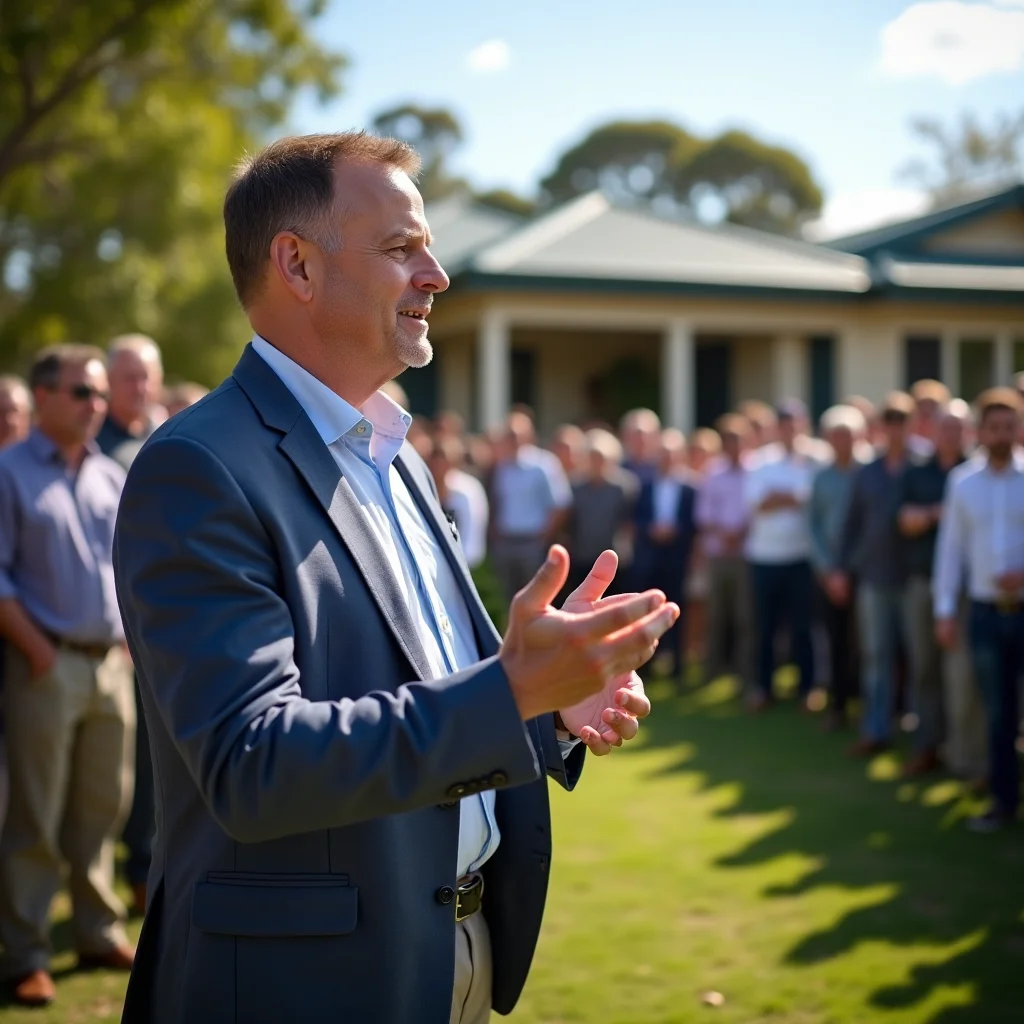
According to REA Group, Brisbane first-home buyer James Miller loaded his cats into the car and drove south to Melbourne after concluding that one specific number made Queensland's capital unworkable for his budget. Miller's decision — publicly reported on September 16, 2026 — crystallises an interstate migration pattern that is simultaneously lifting prices in destination markets and straining affordability in the suburbs left behind. West End (QLD) is now recording 8.8% annual growth and a median of $1,350,000, while Dandenong (VIC) — Melbourne's most accessible outer ring — sits at just $680,000 with 2.3% annual growth, a gap that is driving migration flows in both directions depending on the buyer's profile.
The Number That Moved James Miller: Median Prices as Migration Triggers
Miller's reported calculation is straightforward from a data perspective. Brisbane's inner and middle-ring suburbs have recorded sustained growth across 2025 and into 2026, with West End reaching a $1,350,000 median and Indooroopilly sitting at $1,380,000 — both posting 8.5%–8.8% annual growth. Maroochydore on the Sunshine Coast has reached $1,050,000. For a first-home buyer without an existing property to sell, these price points represent a structural barrier that no grant or concession fully bridges.
Melbourne's affordability proposition is real but concentrated. Dandenong's $680,000 median and Reservoir's $880,000 median offer entry points unavailable in Brisbane's comparable suburban rings. Miller's southward move reflects a rational price-driven decision, not a lifestyle preference — and it is a decision that market data shows is being replicated at scale across the country. Understanding how Days on Market — What It Tells You in each city signals local demand depth is essential context: Dandenong's 40-day sales cycle versus West End's 22 days confirms that Melbourne's more affordable suburbs are seeing softer immediate demand, even as interstate arrivals add incremental pressure.
Queensland's Growth Premium and the Migration Paradox
The core paradox of Queensland's property market in September 2026 is that strong growth is simultaneously attracting investors and repelling the first-home buyers who were previously drawn by relative affordability. West End's 8.8% annual growth and 22-day sales cycle — among the fastest clearance timelines in the Brisbane market — reflect a suburb that has graduated out of first-home buyer territory. Indooroopilly at $1,380,000 and Maroochydore at $1,050,000 are showing similar dynamics, with days on market of 23 and 28 respectively, signalling sustained buyer competition at price points that exclude entry-level purchasers.
This growth premium has a direct migration consequence. Buyers like Miller who were priced out of Brisbane are flowing south to Melbourne, while separate cohorts of southern owner-occupiers and investors continue flowing north to Queensland, attracted by yield and growth momentum. The net effect is cross-directional interstate migration pressure on both markets simultaneously — compressing Melbourne's affordable outer ring while keeping Queensland's premium inner suburbs in high demand from a buyer pool that includes interstate arrivals with equity from prior Sydney or Melbourne sales.
West End (QLD) recorded 8.8% annual growth and a 22-day median sales cycle in September 2026, while Dandenong (VIC) posted 2.3% annual growth over 40 days — a 6.5-percentage-point growth gap and an 18-day clearance gap that define the interstate migration equation for buyers choosing between the two states.
Western Australia as the Third Migration Destination
Western Australia's data presents a third migration pathway that is reshaping national buyer flows. Nedlands recorded 15% annual growth and a $2,200,000 median with a 15-day sales cycle — the fastest clearance speed in this dataset. South Perth posted 13.8% annual growth at $1,450,000 with a 17-day cycle. Mandurah, at the affordable end of the WA spectrum, recorded 10.5% annual growth at $550,000 and a 24-day cycle. These figures collectively indicate that WA is absorbing interstate migration from both NSW and Victoria, with buyers attracted by price-to-growth ratios unavailable in eastern capitals.
Fremantle's $950,000 median and 5.8% annual growth, with a 25-day sales cycle, represents the mid-market WA entry point for interstate buyers who can bring equity from a Melbourne or Sydney sale. The pattern mirrors what happened in Queensland during 2020–2022 but is now running independently of pandemic-era drivers. For macro and interest rate market analysis, the RBA's 4.35% cash rate creates the context: WA's stronger wage growth relative to living costs and its lower median entry points in suburbs like Mandurah make interstate migration financially logical under current borrowing conditions.
NSW Regional Markets and the Counter-Migration Signal
Not all interstate migration flows toward growth markets. Port Macquarie's 48-day sales cycle — the longest in this dataset — and $850,000 median with 3.5% annual growth signals a regional NSW market where buyer depth has thinned following the initial post-pandemic coastal migration wave. Ballina tells a similar story: $1,350,000 median, 4% annual growth, and a 45-day sales cycle with a 47% auction clearance rate. These figures indicate that the regional NSW lifestyle migration cohort that dominated 2021–2023 has contracted sharply under the weight of the RBA's 4.35% cash rate and reduced remote work flexibility.
Liverpool (NSW) at $850,000 and 38 days on market, versus Surry Hills at $1,920,000 and 23 days, illustrates that within NSW, migration pressure remains concentrated in inner Sydney. Buyers who might have targeted regional NSW are now reconsidering, either remaining in capital city commuter belts or — as Miller's case demonstrates — crossing state lines entirely. The Sydney Morning Herald reported on September 15 that buyers are hanging back even in markets where prices have softened, citing fears of overpaying — a dynamic that concentrates active purchasing decisions among the most motivated, financially prepared buyers, including interstate migrants who have already done the price comparison work.
What the Migration Data Signals for Agents, Vendors, and Buyers
For agents operating in high-growth markets like West End, South Perth, or Nedlands, the interstate buyer pool is a structural feature of demand rather than an occasional factor. West End's 62% auction clearance rate and 22-day cycle confirm competitive conditions that justify vendor-friendly campaign strategies. In WA's premium suburbs, Nedlands' 65.5% clearance rate and 15-day cycle mean vendors can price confidently. The practical implication: agents in these markets who do not actively market to interstate buyers — particularly to east-coast owner-occupiers with equity — are missing the cohort most capable of meeting current price expectations without financing contingency delays.
For buyers considering interstate moves, Miller's decision to relocate from Brisbane to Melbourne illustrates that the migration calculation has inverted in specific segments. Melbourne's Dandenong at $680,000 now offers a lower entry point than any comparable Brisbane suburban ring, and its 2.3% annual growth, while modest, at least preserves purchasing power relative to Queensland's accelerating median. In slower NSW regional markets, buyers have more negotiating room — Port Macquarie's 48-day average sales cycle and 46% clearance rate confirm vendor competition for a reduced buyer pool — though the Australian Property Market Overview context matters: rate sensitivity remains the dominant constraint regardless of which state a buyer targets. The interstate migration trend will continue to be a primary price driver across WA, QLD, and Victoria's outer ring through the remainder of spring 2026, with each market's clearance rate and days on market serving as the most reliable real-time indicators of where that demand is concentrating.