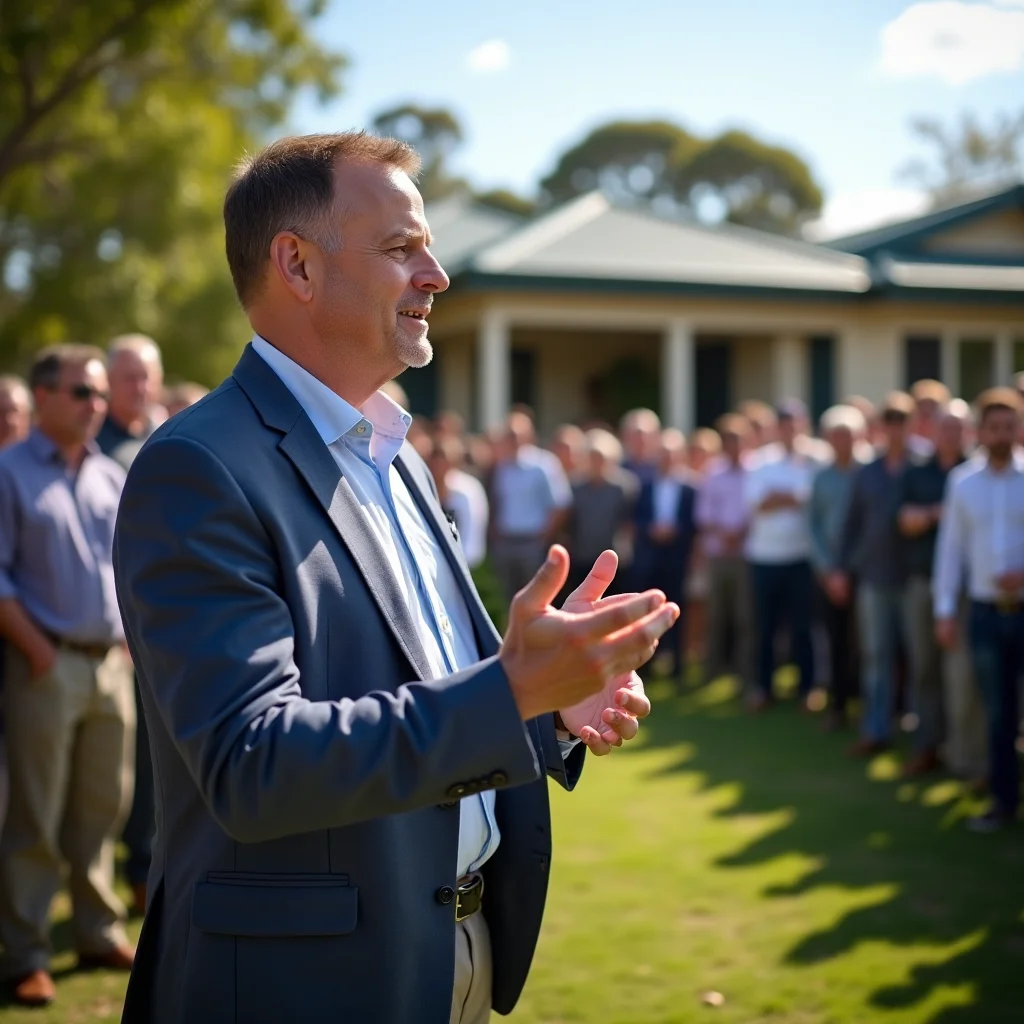
According to REA Group, couples earning up to $650,000 annually are currently eligible for taxpayer-funded first home buyer assistance — a policy threshold now drawing sharp criticism as suburb-level data reveals median prices ranging from $550,000 in Mandurah, WA, to $2,650,000 in Kirribilli, NSW. With the RBA cash rate held at 4.35% and PropTrack recording a national median of $894,000, the income eligibility ceiling sits so far above median household earnings that the scheme functions less as targeted relief and more as a broad subsidy for high-income purchasers in mid-tier markets.
Income Eligibility Thresholds vs Real Suburb Affordability
The policy trigger is straightforward: if couples earning $650,000 per year qualify for government assistance, the scheme's affordability rationale collapses under its own logic. At a combined income of $650,000, a couple can service a mortgage well above $3,000,000 at current rates — placing virtually every suburb in this dataset within reach without government support. The eligibility ceiling was designed for genuine housing stress, not for buyers competing in Randwick at a $2,400,000 median or Surry Hills at $1,920,000.
At the lower end of the market, the affordability picture is materially different. Mandurah, WA, carries a $550,000 median with 10.5% annual growth — a suburb where government assistance could plausibly shift buyer capacity. Dandenong, VIC, sits at $680,000 with just 2.3% annual growth and a 40-day median days-on-market figure, signalling genuine buyer hesitation in one of Melbourne's most accessible price tiers. Reservoir, VIC, at $880,000 and Penrith, NSW, at $880,000 represent the outer edge of markets where a deposit gap — not income — remains the primary barrier to entry. For these buyers, targeted support makes a structural difference. For a dual-income household earning $650,000, it does not.
The means-testing debate also intersects with the broader Australian property market, where affordability is not a single national condition but a patchwork of 20 distinct suburb realities. Port Macquarie, NSW, records an $850,000 median alongside a 46% auction clearance rate and 48 days on market — a market where buyers hold negotiating power. Liverpool, NSW, mirrors that $850,000 median with a 38-day sales cycle and a 60.5% clearance rate. Neither market is cheap by historical standards, but both sit well below the price points where a $650,000-income household faces genuine affordability stress.
Western Australia's Growth Premium Widens the National Affordability Gap
The affordability debate cannot be separated from the divergent growth rates now reshaping purchasing power across states. Nedlands, WA, recorded 15% annual growth to reach a $2,200,000 median — and it clears stock in just 15 days at a 65.5% auction clearance rate. South Perth, WA, posted 13.8% growth to $1,450,000 with a 17-day sales cycle and a 63.5% clearance rate. Mandurah added 10.5% to reach $550,000. In a single state, WA now spans a $1,650,000 price range between its most affordable and most prestigious tracked suburb — and both ends of that range are appreciating faster than the national median.
This growth dynamic has a direct bearing on first home buyer policy. A scheme calibrated to income thresholds set in a lower-price environment is now operating in a market where WA's entry-level suburbs are rising at rates that erode deposit savings faster than they accumulate. Fremantle, WA, at $950,000 with 5.8% annual growth and a 25-day sales cycle represents a market where a 10% deposit target is a moving goalpost — adding roughly $55,000 in price per year at current growth rates. For genuine first home buyers in these markets, the gap between saving and buying is widening regardless of whether a grant is available.
South Perth's $1,450,000 median has risen 13.8% in 12 months — adding approximately $200,000 in price while a first home buyer saving a standard 20% deposit would need to accumulate an additional $40,000 in the same period just to keep pace with the entry price.
Queensland's Mid-Tier Markets and the True First-Home Price Band
Queensland markets provide the clearest evidence of where first home buyer policy should be targeted. Maroochydore recorded an $1,050,000 median with 8.5% annual growth and a 28-day sales cycle — a market growing fast enough to price out buyers who cannot move quickly. West End, QLD, sits at $1,350,000 with 8.8% annual growth and a 22-day days-on-market figure. Indooroopilly reached $1,380,000 with 8.5% growth and clears in 23 days at a 62.5% clearance rate.
These are not prestige markets. They are mid-tier Brisbane and inner-Brisbane fringe suburbs where first home buyers compete directly against upgraders, investors, and interstate migrants. At these price points, a $650,000 household income does not face a deposit problem — it faces a competition problem. The policy question is whether government assistance should be directed at accelerating that competition or at building capacity for genuinely income-constrained buyers in markets like Port Macquarie, Ballina at $1,350,000 with a 47% clearance rate and 45 days on market, or Newtown, VIC, at $950,000 with a 52% clearance rate.
For context on how income thresholds and grant structures interact with auction dynamics, the REAStats guide to Auction Underquoting in Australia — How It Works, Why It Happens, and Your Rights outlines the ways policy-adjacent market behaviours can distort price signals at the entry level — a mechanism particularly active in Queensland's fast-clearing mid-tier markets where price guides frequently understate competition. For a broader cross-country perspective on how government housing schemes interact with affordability, macro and interest rate market analysis tracks how monetary policy settings at 4.35% are amplifying the impact of stimulus-style grants on already-competitive price tiers.
Sydney's Prestige Tier and the Misaligned Policy Signal
The most acute mismatch between scheme design and market reality appears at Sydney's upper-mid tier. Kirribilli's $2,650,000 median and Randwick's $2,400,000 median sit far above what any first home buyer scheme could plausibly address. But below those prestige markers, suburbs like Surry Hills at $1,920,000 with 5.5% annual growth and a 73% auction clearance rate represent markets where buyers earning $650,000 are active and competitive — and where a government grant adds purchasing power to an already-pressured market without targeting genuine hardship.
Penrith at $880,000 and Liverpool at $850,000 — both with days-on-market figures of 35 and 38 days respectively, and clearance rates of 62% and 60.5% — are the Sydney suburbs where first home buyer demand is most concentrated and most price-sensitive. These markets sit at roughly one-third the price of Randwick and one-quarter the price of Kirribilli. At the RBA's 4.35% cash rate, the monthly repayment difference between a $880,000 Penrith purchase and a $2,400,000 Randwick purchase — assuming 80% LVR — is approximately $7,800 per month. The income threshold for the scheme spans buyers whose monthly repayment capacity differs by that margin.
Victorian Affordability Pressure and the Sub-$700k Market
Victoria presents the clearest affordability stratification. Dandenong at $680,000 with 2.3% annual growth is one of the few suburbs in this dataset where an entry-level buyer on a single income faces a genuine deposit and serviceability gap at 4.35%. Its 40-day days-on-market figure and 56% clearance rate confirm buyer hesitation — this is a market where price sensitivity is real and where assistance is logically targeted. Reservoir at $880,000 with 2.8% growth and a 32-day sales cycle sits in a similar bracket, though price momentum is marginally stronger.
At the other end of Victoria's spectrum, Toorak at $2,800,000 with a 72% clearance rate and 23 days on market, and Kew at $2,100,000 with a 71% clearance rate and 24 days on market, operate as effectively self-clearing prestige markets where first home buyer policy is structurally irrelevant. Prahran at $1,550,000 with 3.9% growth and a 69% clearance rate sits in the zone where a $650,000 household income is fully competitive without assistance — and where a grant would primarily compress the savings period by a matter of months rather than enabling a purchase that would otherwise be impossible.
The data signal for vendors, buyers, and agents entering the spring 2026 season is that the first home buyer scheme — as currently structured — is operating as a broad market stimulus rather than a targeted affordability intervention. Agents in Dandenong, Penrith, Reservoir, and Port Macquarie serve buyers for whom means-tested assistance would be genuinely market-enabling. Agents in Surry Hills, West End, and Maroochydore operate in markets where high-income grant recipients simply represent additional competition in already-tight price bands. Vendors in fast-clearing WA markets — South Perth at 17 days, Nedlands at 15 days — are already benefiting from compressed supply; additional buyer stimulus in those markets adds upward price pressure that any means-testing reform would partially counteract. For buyers at the genuine first-home price tier, a tighter eligibility structure would reduce competition from higher-income purchasers in the $800,000–$1,100,000 band where real affordability stress is most concentrated.