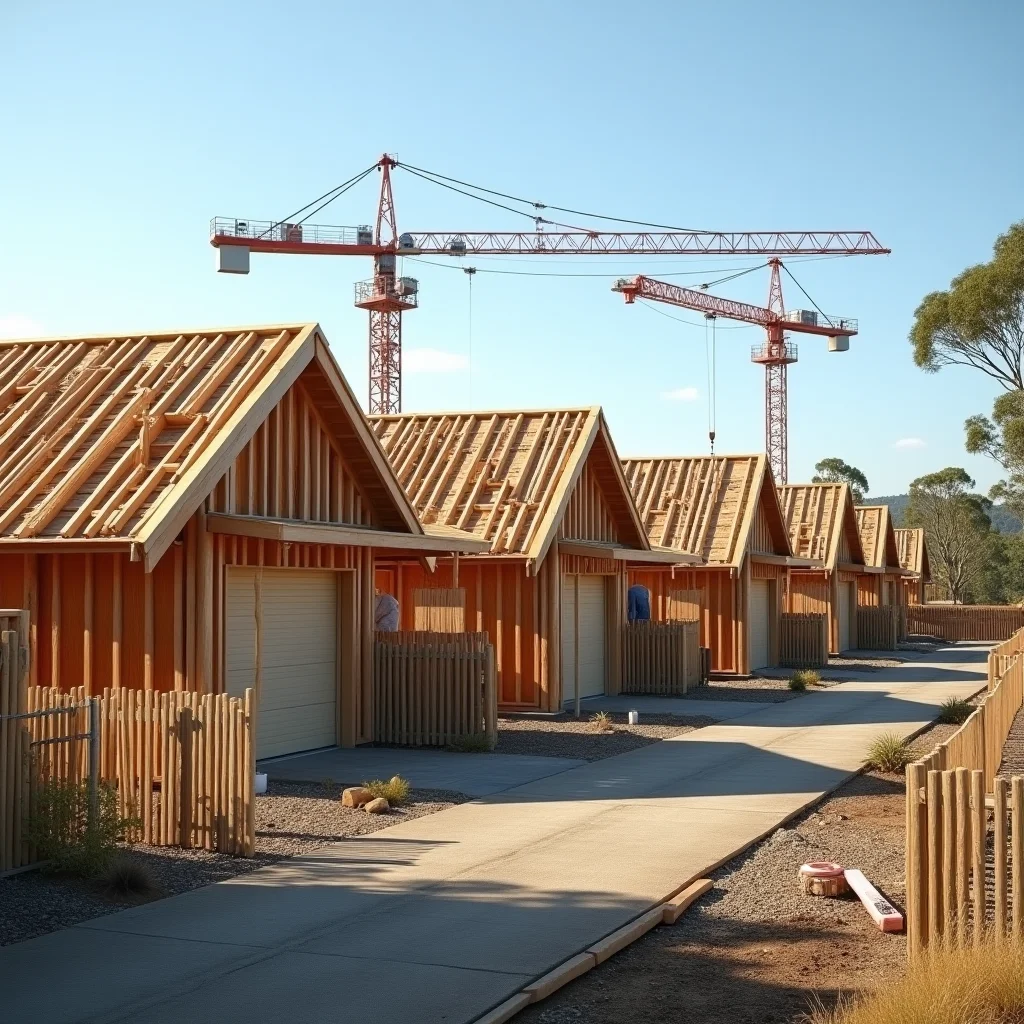
According to REA Group, granny flat search volumes have been rising all year across Queensland, with builders now expecting to produce ten times their previous output as housing crisis pressures drive investors toward dual-income strategies on established properties. That surge is landing directly inside the new versus established property investment debate — and it's shifting the numbers in favour of established stock with add-value potential.
Development Victoria's New Estate Signals Where New Stock Is Entering the Market
According to REA Group, Development Victoria has commenced a 400-home estate in Melbourne's east on a former government pesticide testing facility. For investors, the launch raises a familiar question: does new greenfield stock in outer metropolitan areas offer better long-term returns than established property closer to employment centres?
The data from Melbourne's established inner-ring suburbs points clearly in one direction. Toorak's median price sits at $2,800,000 with 4.5% annual growth and a 72% auction clearance rate at just 23 days on market. Prahran records $1,550,000 with 3.9% annual growth and a 69% clearance rate. Kew trades at $2,100,000 with 4.4% annual growth. By contrast, Dandenong — Melbourne's outer east, the broader corridor where new estate supply is entering — records only 2.3% annual growth at an $880,000 median with a 40-day average days on market and a 56% clearance rate. The liquidity gap between inner-established and outer-new stock is substantial.
New estates frequently offer depreciation benefits and lower maintenance costs in the early years, which can improve short-term cash flow on a 4.35% RBA cash rate environment. But the land component of a greenfield property — where scarcity value is minimal at launch — tends to underperform established land parcels with genuine location scarcity over five to ten year horizons.
Granny Flat Returns: The Established Property Advantage That Data Is Now Quantifying
The granny flat demand surge reported by REA Group represents a structural shift in how investors are extracting yield from established residential land. Builders expecting to produce ten times their previous output signals that secondary dwelling construction is moving from niche strategy to mainstream approach — and it is almost exclusively an established property play.
Established properties on larger blocks in established suburbs offer the land configuration, council zoning approval pathways, and existing infrastructure connections that greenfield properties in new estates typically cannot replicate. West End QLD, with an $1,350,000 median, 8.8% annual growth, and 22 days on market, typifies the inner-urban established profile where secondary dwelling potential adds a yield layer on top of already-strong capital growth. Maroochydore at $1,050,000 with 8.5% annual growth and 28 days on market presents a similar dual-income opportunity in the Queensland regional growth corridor.
Nedlands WA recorded 15% annual growth at a $2,200,000 median with an average 15 days on market — the fastest sales cycle in the current dataset — while Mandurah WA delivered 10.5% annual growth at a $550,000 entry point, the highest growth rate in the dataset relative to its price point. Both are established suburb markets with no competing new estate supply at scale.
The granny flat calculation is direct: a secondary dwelling generating $500–$700 per week in rental income on an established property in Maroochydore or West End creates a yield overlay that new estate investors in Dandenong's 2.3% growth corridor cannot easily replicate without equivalent land configurations.
Suburb-Level Growth Differentials Expose the New Stock Supply Risk
One of the most consistent risks in new property investment is supply competition — when multiple developers build simultaneously in a precinct, values compress. The established suburb dataset tells a different story. South Perth records 13.8% annual growth at $1,450,000 with only 17 days on market. Nedlands at 15% annual growth is being absorbed at 15-day cycles despite a $2,200,000 median. These are markets where supply is structurally constrained by geography, existing development density, and heritage overlays.
Compare that with new estate corridors, where supply response is elastic — developers bring new lots to market when prices rise, which caps upside. Development Victoria's 400-home release is a textbook example: government-sponsored supply entering a market where prices have been rising. For investors targeting capital growth over a 7–10 year horizon, the supply cap that established suburbs offer is a meaningful structural advantage.
New South Wales regional data reinforces the point from a different angle. Port Macquarie records only 3.5% annual growth at an $850,000 median with 48 days on market and a 46% clearance rate. Ballina, also NSW regional, sits at 4% growth with 45 days on market. These are not new estate markets — they are established regional markets — but they demonstrate that location fundamentals outweigh property age. Established property in the wrong location still underperforms established property in supply-constrained high-demand markets.
The Shock Sale Signal: Affordable Suburbs Breaking Price Records
According to REA Group, a home in one of Australia's most affordable capital city areas just set a suburb record, beating the previous high by more than $1 million — a result that underscores the price discovery risk in markets previously dismissed as low-growth. For investors comparing new versus established options, this pattern is significant: established dwellings in affordable established suburbs can produce asymmetric upside when buyer demand concentrates.
New estate properties rarely produce equivalent record-breaking results because comparable sales benchmarks are set by volume — hundreds of similar dwellings transact in any given quarter, anchoring prices tightly. Established suburbs with heterogeneous housing stock, where each property has unique land, orientation, and configuration attributes, allow for price discovery that new estates structurally cannot support.
Mandurah at $550,000 median with 10.5% annual growth illustrates this. An established coastal property in a low-supply environment producing double-digit annual growth delivers a total return profile that a new estate at equivalent price in a high-supply outer corridor cannot match without exceptional execution on depreciation schedules and rental yield.
New Property Depreciation vs Established Capital Growth: Running the Numbers at 4.35%
At the RBA cash rate of 4.35%, the holding cost of investment property is material. New properties offer building depreciation schedules that reduce taxable income — typically $10,000–$20,000 per year in the early years of a new build, depending on construction cost. For high-income investors, this reduces the after-tax cost of holding. That is the strongest structural argument for new property in the current rate environment.
Established properties cannot claim equivalent depreciation on building structure for purchases post-July 2017 (the federal budget change restricts investors from claiming depreciation on second-hand assets). However, the capital growth differential in the data is stark: Nedlands at 15%, Mandurah at 10.5%, South Perth at 13.8%, and West End QLD at 8.8% represent growth rates that compress the depreciation advantage of new property within two to three years of holding.
For investors building a portfolio with international diversification in mind, the same principle applies — understanding the growth mechanics of different asset classes is foundational, as outlined in the Investing in International Property from Australia guide on REAStats. Established markets with genuine scarcity dynamics tend to outperform supply-elastic new construction over equivalent holding periods, whether the comparison is domestic or cross-border. The historical Australian property bubble analysis at Bubblepedia further contextualises how new supply cycles have historically contributed to price compression in outer corridors while inner established markets recovered faster after downturns.
Former Woolworths and Ticketek chief executive Brad Banducci's $3 million Sydney investment property sale, reported by SMH Property, adds another data point: sophisticated investors continue to transact in established Sydney markets at price points that confirm demand for proven established stock remains active, even as broader Sydney auction clearance rates face pressure.
For investors assessing the new versus established decision in mid-2026, the data signals are consistent: established property in supply-constrained suburbs — particularly in Western Australia and Queensland — is delivering growth rates that dwarf new estate performance, granny flat additions are creating yield stacking opportunities unavailable to new estate buyers, and the shock price records appearing in affordable established suburbs suggest further price discovery upside in markets that new estate developments structurally cannot replicate. At 4.35%, the depreciation benefit of new property is real but narrow — and the growth differential in markets like Nedlands and Mandurah suggests it is being closed faster than the depreciation schedule runs.

