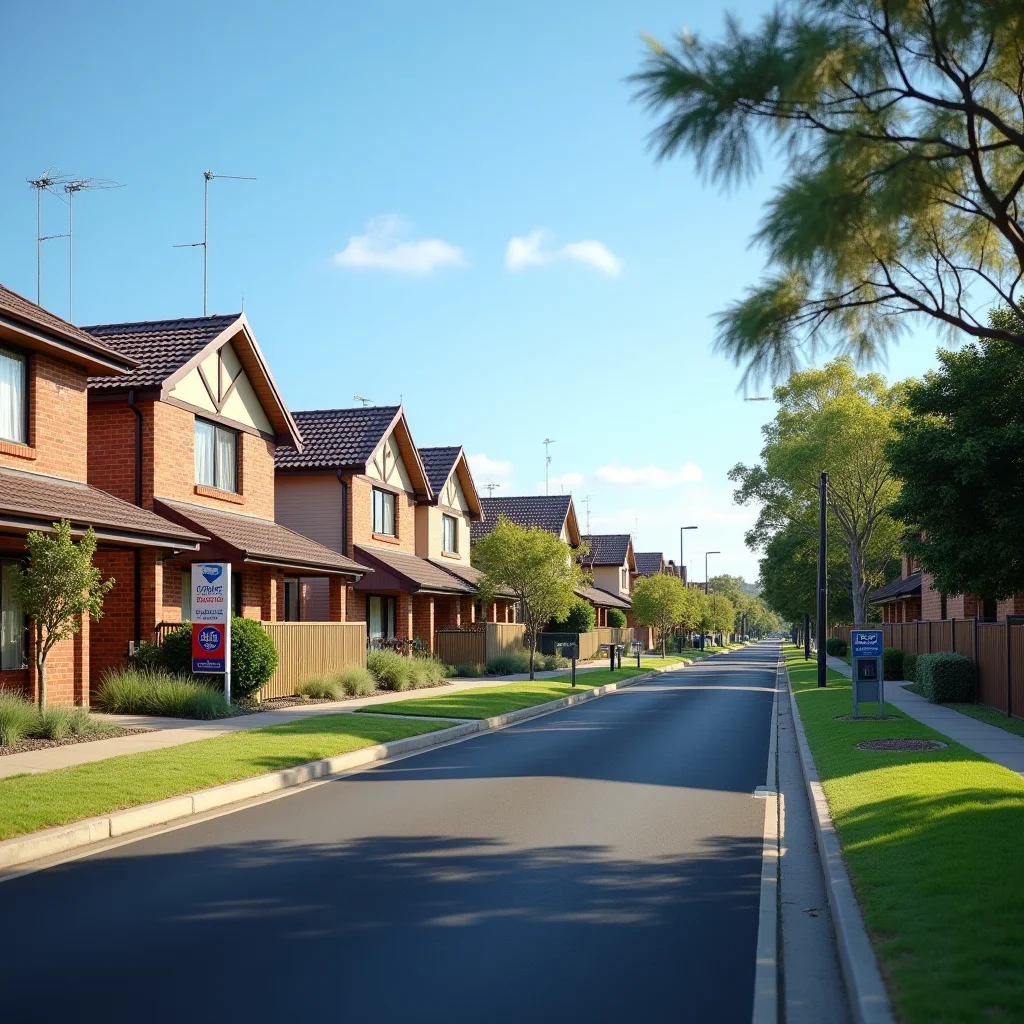
A pair of South Yarra art deco homes passed in at auction on a $2m vendor bid on September 20, 2026, according to SMH Property, with bidders split between those seeking a semi plus an investment property and others pursuing a single family home conversion — a bifurcation that illustrates exactly where Melbourne's investor demand is stalling. While Victorian prestige markets struggle to close deals, regional Queensland and Western Australian markets are posting growth rates that Victoria's premium suburbs cannot match at any price point.
The South Yarra Pass-In as a Victorian Investor Signal
The South Yarra auction outcome on September 20 is not an isolated event — it is consistent with the broader data pattern across Victorian markets in spring 2026. Prahran, just one suburb from South Yarra, recorded annual growth of 3.9% to a $1,550,000 median, with properties spending 25 days on market and an auction clearance rate of 69%. Toorak, Victoria's most prestigious suburb, posted 4.5% annual growth to a $2,800,000 median. Both figures are positive, but neither approaches the returns available in WA or Queensland regional markets at a fraction of the entry price.
The pass-in result itself reflects a structural tension in Melbourne's investor segment. Buyers considering a semi plus investment property at the $2m level are weighing gross yields, holding costs under the RBA's 4.35% cash rate, and capital growth prospects simultaneously. At 3.9%–4.5% annual growth, Victorian prestige assets require either significant rental income or a long holding period to justify acquisition costs. For investors prepared to look beyond state borders, the arithmetic shifts materially.
Dandenong, Victoria's most affordable suburb in this dataset, underscores the challenge at the entry level: 2.3% annual growth to a $680,000 median, 40 days on market, and a 56% clearance rate. An investor entering Dandenong today at the RBA's 4.35% cash rate is carrying a high-cost debt against an asset appreciating at less than half the rate of Mandurah or Maroochydore.
Maroochydore and West End: Queensland's Regional Case
Maroochydore on Queensland's Sunshine Coast recorded 8.5% annual growth to a $1,050,000 median in September 2026, with properties clearing in 28 days and an auction clearance rate of 54%. The 28-day sales cycle signals active demand without the frenzied compression seen in WA premium suburbs — a market where investors can conduct reasonable due diligence without being outcompeted by cash buyers operating in sub-20-day windows.
Brisbane's inner-city West End posted the strongest Queensland growth figure in this dataset: 8.8% annually to a $1,350,000 median, with a 22-day sales cycle and 62% auction clearance rate. West End's performance reflects the combined effect of inner-city infrastructure investment, interstate migration inflows, and constrained supply in walkable urban precincts. At 22 days on market, the suburb is operating in seller's market territory — properties are not lingering.
Indooroopilly rounds out Queensland's strong performers, matching Maroochydore's 8.5% annual growth to a $1,380,000 median. Its 23-day sales cycle and 62.5% clearance rate confirm that Brisbane's middle-ring suburbs with lifestyle attributes and proximity to the University of Queensland are sustaining investor demand despite the 4.35% rate environment. For investors seeking both growth and rental demand, university-adjacent suburbs with sub-25-day cycles represent a measurable entry point.
Maroochydore's 8.5% annual growth and 28-day sales cycle compares directly to Dandenong's 2.3% growth and 40-day cycle — a 6.2 percentage point growth gap and 12-day liquidity advantage in favour of the Queensland regional market at a $370,000 lower median price entry point.
Mandurah and Fremantle: WA's Regional Investment Arithmetic
Mandurah, Western Australia's most affordable suburb in this dataset, recorded 10.5% annual growth to a $550,000 median in September 2026 — the highest growth rate per dollar of entry cost of any market tracked here. Properties cleared in 24 days with a 56% auction clearance rate. For investors operating under the RBA's 4.35% cash rate, Mandurah's combination of sub-$600,000 entry, double-digit growth, and sub-25-day liquidity presents a fundamentally different risk-return profile than Victorian equivalents at similar price points.
Fremantle, WA's coastal urban market, posted 5.8% annual growth to a $950,000 median with a 25-day sales cycle and 54.6% clearance rate. Fremantle sits between Mandurah's high-growth affordable positioning and South Perth's premium tier — useful for investors seeking urban amenity with WA's structural growth tailwind, without committing to the $1,450,000 median that South Perth now commands after its 13.8% annual growth run.
South Perth's 13.8% growth to $1,450,000 and 17-day sales cycle confirms that WA's premium near-city suburbs have already re-rated significantly. Investors entering South Perth today are buying into a market where annual growth has compressed the yield base and the days-on-market figure reflects acute stock shortage rather than broad-based demand. Mandurah and Fremantle offer WA exposure without the entry-level compression that now defines Nedlands ($2,200,000 median, 15% growth, 15 days on market) and South Perth.
Port Macquarie vs Ballina: NSW Regional Markets Lag
NSW's regional markets present a more cautious picture for investors in September 2026. Port Macquarie recorded 3.5% annual growth to an $850,000 median, but with 48 days on market and a 46% auction clearance rate, the suburb is operating in buyer's market conditions. A 48-day sales cycle at 46% clearance means vendors are regularly revising expectations, and investors entering this market carry meaningful liquidity risk if circumstances require a sale within a standard 12–24 month horizon.
Ballina, the Northern Rivers market, posted 4.0% annual growth to a $1,350,000 median — a notably high entry price for 45 days on market and a 47% clearance rate. Ballina attracted significant pandemic-era capital from Sydney buyers, and that price re-rating has not been followed by the demand depth needed to sustain auction clearance rates above 50%. At $1,350,000 with a 45-day sales cycle, Ballina's risk-adjusted return profile is materially weaker than Maroochydore at the same price point with 8.5% growth and 28-day clearance.
Liverpool (NSW) recorded identical growth to Port Macquarie at 3.5% but at an $850,000 median with a 38-day sales cycle and 60.5% clearance — a more liquid outcome than Port Macquarie, though still well below Queensland or WA regional equivalents. For investors weighing historical Australian property bubble analysis against current regional entry points, the NSW regional data suggests caution where price re-ratings from 2020–2022 have not been absorbed by underlying demand.
Background: Regional vs Metropolitan Investment Strategy
The capital city versus regional investment debate has been a structural feature of Australian property cycles for decades. Regional markets typically offer higher rental yields, lower entry prices, and exposure to local economic drivers — but carry liquidity risk that metropolitan markets absorb more efficiently. The September 2026 data complicates this binary: Queensland and WA regional markets are simultaneously delivering higher capital growth and shorter sales cycles than Victorian metropolitan equivalents, a combination that rarely persists across a full cycle.
Investors considering cross-border or regional diversification should review the Investing in International Property from Australia framework alongside domestic regional data — the same principles of currency-equivalent yield comparison, liquidity assessment, and tax treatment that apply offshore apply when comparing Mandurah to Dandenong or Maroochydore to Liverpool. The REAStats Australian Property Market Overview provides the broader cycle context for positioning regional entries against metropolitan benchmarks.
According to Property Update, successful property investment generally involves holding quality assets for the long term, allowing compounding capital growth to work in your favour — a principle that applies directly to the current regional opportunity window. Markets with 8%–10% annual growth and sub-30-day sales cycles are compounding investor equity at rates that sub-4% Victorian markets cannot replicate, regardless of holding period length.
What the Data Signals for Investors in September 2026
The South Yarra pass-in on a $2m vendor bid is a single data point, but it lands in a context where the broader investment case for Victorian prestige markets is under measurable pressure. Investors who would have anchored to Melbourne's inner suburbs as the default allocation are now comparing 3.9%–4.5% Victorian growth against Maroochydore's 8.5%, Mandurah's 10.5%, and South Perth's 13.8% — all under the same 4.35% RBA cash rate that applies to every leveraged acquisition nationally.
The liquidity data reinforces the growth differential. Maroochydore at 28 days, West End at 22 days, and Mandurah at 24 days all clear faster than Dandenong at 40 days or Port Macquarie at 48 days. Regional WA and Queensland markets are not just growing faster — they are selling faster, which means investor exit risk is lower than the Victorian and NSW regional equivalents that headline regional investment conversations.
For vendors in underperforming regional NSW markets, the clearance data below 50% in Port Macquarie and Ballina is a direct instruction to price realistically from day one. For buyers, those same figures represent the conditions under which negotiated discounts are achievable. For investors building a multi-asset portfolio, the September 2026 data points clearly toward Queensland coastal and WA near-metropolitan markets as the current sweet spot between growth rate, entry price, and sales cycle liquidity — before the next leg of WA's re-rating closes the affordability window that Mandurah still represents.

