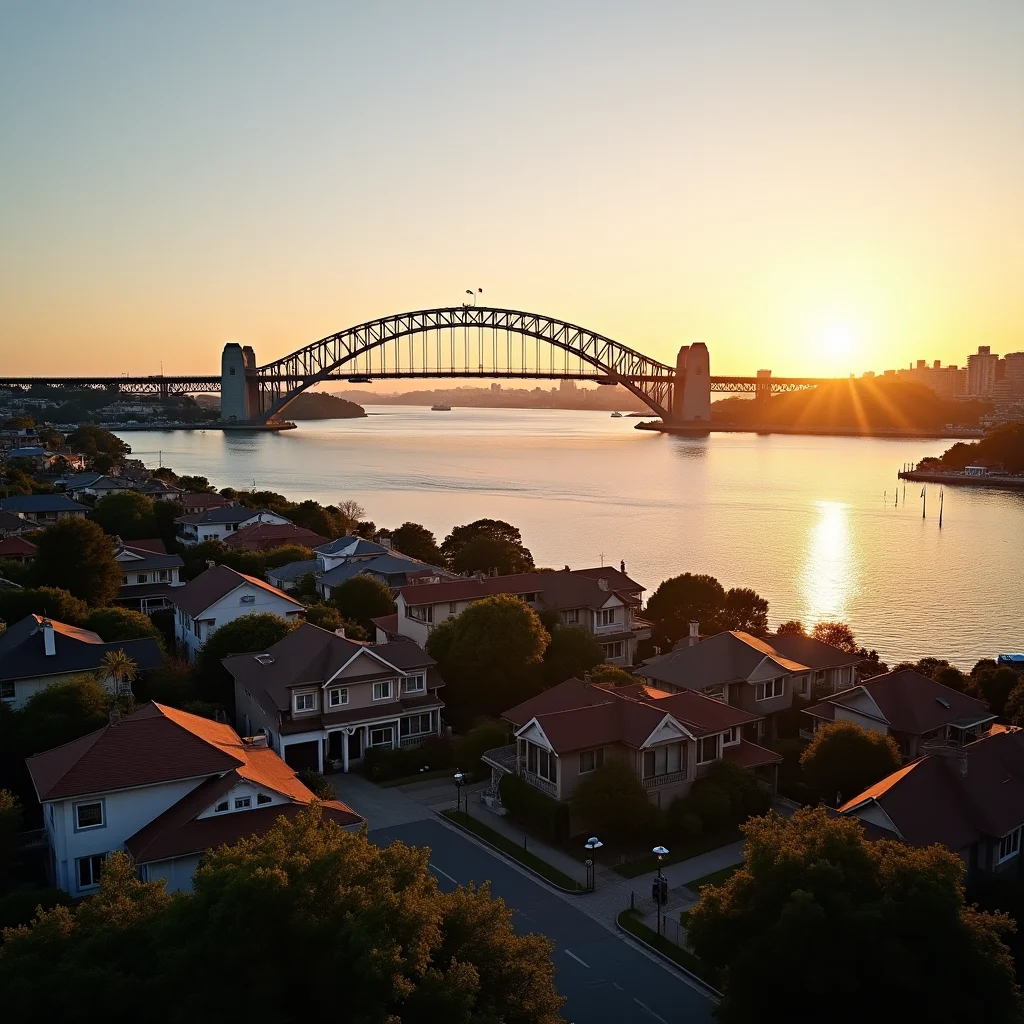
New South Wales continues to establish a distinct performance advantage over Victoria in the national property landscape, with median annual growth in its suburbs reaching 4.6% compared to 3.7% in Victoria. This 0.9 percentage point differential, while seemingly modest, translates to considerable value divergence in Australia's two largest property markets. The data underscores a bifurcated market where premium postcodes in both states exhibit remarkable resilience, consistently commanding auction clearance rates above 70% even as the broader market digests the impact of a 4.10% RBA cash rate and persistent inflationary pressures.
Price Performance Reveals A Deepening Interstate Divide
The performance gap between NSW and Victorian property markets is most pronounced in absolute median values, reflecting fundamentally different supply-and-demand structures. NSW premium suburbs command a significant price premium, with the harbour-side enclave of Mosman recording a $4.2 million median and the iconic Bondi Beach reaching $3.1 million. By comparison, Victoria's most prestigious market, Toorak, registers a $2.8 million median, with the bayside suburb of Brighton following at $2.4 million. This valuation gap highlights Sydney's status as a global financial hub and its geographically constrained housing supply, which intensifies price pressure on desirable assets.
This pricing hierarchy permeates mid-tier markets as well. Well-connected NSW suburbs with strong school catchments and infrastructure, such as Epping ($1.58 million) and Chatswood ($2.2 million), consistently outpace their Victorian counterparts. Comparably positioned suburbs in Melbourne, like Essendon ($1.52 million) and Kew ($2.1 million), offer relative affordability but reflect a less concentrated economic landscape and greater potential for urban expansion, which tends to moderate price ceilings. This structure suggests that underlying economic drivers and urban geography are key determinants of value across both states.
Auction Metrics Signal Enduring Blue-Chip Demand
Auction clearance rates, a critical real-time indicator of market sentiment, reveal pockets of intense competition, particularly at the premium end. Premium NSW suburbs demonstrate superior auction performance, with Bondi Beach achieving a robust 74.2% clearance rate and Mosman recording a solid 72.5%. This indicates that for high-quality, well-located properties, multiple bidders are prepared to compete fiercely. Victorian premium markets show similar strength, with Toorak at 72% and Camberwell at 71.5%, signalling that demand from buyers less sensitive to interest rate fluctuations remains deep-seated for A-grade assets.
Mid-tier NSW suburbs maintain clearance rates between 65.8% and 69%, while comparable Victorian areas range from 62% to 68%, suggesting NSW buyers remain more active across price segments.
The broader depth of the NSW market is evident in its mid-tier performance. Suburbs like Rhodes (69%) and Epping (68.5%) are outperforming Victorian equivalents such as Box Hill (65.5%) and Reservoir (62%). This pattern suggests that buyer confidence and willingness to transact are more widely distributed across the Sydney basin than in metropolitan Melbourne, where buyer activity appears more concentrated in prime locations.
Sales Velocity Underscores Market Liquidity
Days on market (DOM) metrics provide a clear measure of sales velocity and underlying market liquidity. Premium properties in both state capitals are moving quickly, though NSW maintains a slight edge. Luxury suburbs in Sydney are averaging 20-25 days on market, with Bondi Beach leading at a rapid 20 days, followed by Mosman at 22 days and Paddington at 25 days. This swift turnover minimises holding costs for vendors and signals a high degree of buyer immediacy.
Victorian premium suburbs are not far behind, demonstrating competitive liquidity with properties in Toorak selling within 23 days and Brighton within 24 days. The more significant divergence appears in the mid-tier segments. Victorian suburbs such as Reservoir (32 days) and Box Hill (30 days) show notably extended marketing periods compared to the 27-to-28-day averages seen in comparable NSW markets. This suggests that while top-tier properties are liquid in both cities, the depth of active buyers in NSW extends further down the price ladder, providing sellers with greater transactional certainty.
Strategic Implications for Market Participants
The statistical divergence between NSW and Victoria necessitates distinct strategic approaches from buyers, sellers, and investors. For purchasers, the NSW market presents a high-cost, high-growth environment, whereas Victoria offers more accessible entry points with the trade-off of more moderate, albeit consistent, appreciation. The growth rate analysis confirms this, with select NSW suburbs like Bondi Beach delivering 6.1% annual appreciation, at the top of a 3.9% to 6.1% range. Victorian counterparts in Camberwell and Toorak top out at 4.5-4.6%, within a tighter 2.8% to 4.6% band.
- Investors may view Sydney as a "blue-chip" destination, justifying the higher capital outlay with stronger growth potential and robust rental demand driven by its international status. Melbourne, conversely, aligns with a value-and-yield strategy, where lower acquisition costs can facilitate better rental returns and a more diversified portfolio.
- Sellers in NSW, particularly in the premium and mid-tier segments, are operating in a favourable environment characterised by strong buyer competition and rapid sales. Victorian vendors in prime postcodes enjoy similar conditions, but those in outer rings may need to be more attuned to local supply levels and price expectations to secure a timely sale.
Ultimately, the data shows NSW markets maintaining stronger upward momentum, positioning the state for continued outperformance. This is fuelled by a confluence of concentrated economic activity, constrained supply, and sustained demand from both domestic and international buyers.
What to Watch
Looking ahead, several key factors will shape the trajectory of both markets. The Reserve Bank of Australia's future monetary policy decisions remain the most immediate variable; any further tightening could weigh on borrowing capacity and temper buyer sentiment, particularly in price-sensitive mid-tier segments. The pipeline of new housing supply, as tracked by the ABS, will be critical to monitor—a significant increase in listings could test the resilience of current clearance rates. Furthermore, population trends, especially the rate of overseas migration, will continue to be a primary driver of housing demand in both Sydney and Melbourne. Finally, any regulatory shifts from bodies like APRA concerning lending criteria or state-level changes to property taxation could materially alter market dynamics and the performance gap between the two states.