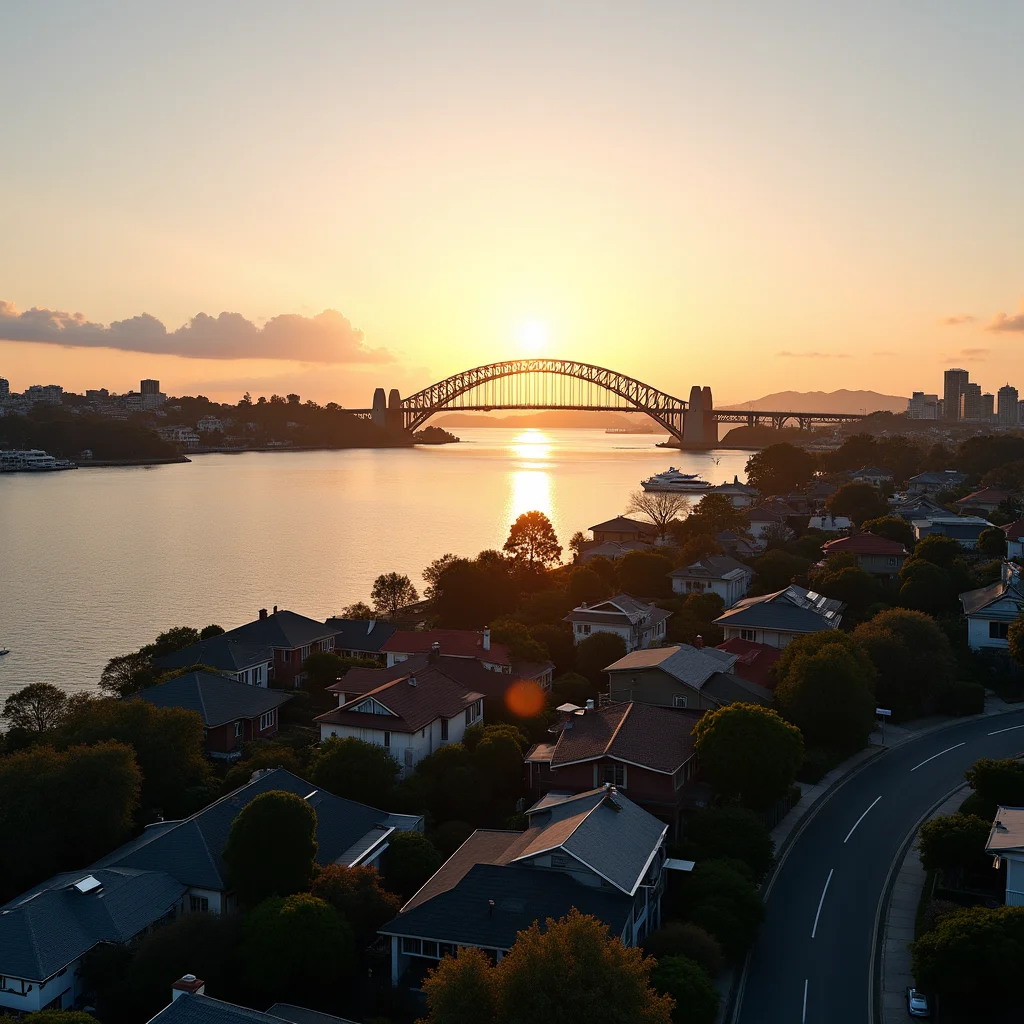
A detailed analysis of property market performance reveals a significant growth divide between Australia’s two largest states, with New South Wales properties delivering a 4.6% average annual growth rate compared to Victoria's 3.8%. This 0.8 percentage point differential, derived from a sample of 20 representative suburbs, aligns with broader market indices from data providers like CoreLogic, which have consistently shown Sydney’s market outpacing Melbourne's in recent quarters. The performance gap extends beyond simple price appreciation, with NSW suburbs averaging 25 days on market (DOM) versus Victoria's 27 days, indicating stronger buyer demand and greater market liquidity in the nation's most populous state.
These trends are unfolding within a challenging macroeconomic environment shaped by the Reserve Bank of Australia's (RBA) cycle of interest rate hikes. The sustained increase in the official cash rate has dampened borrowing capacity across the board, yet the market impact has not been uniform. The data suggests NSW's stronger economic fundamentals, including robust employment and higher net international migration figures reported by the Australian Bureau of Statistics (ABS), are providing a more resilient buffer against these headwinds.
Premium Suburb Performance Metrics
Analysis of the top-tier market segments reveals a pronounced clustering of high-performing suburbs within premium price brackets in both states. These enclaves appear more insulated from the credit tightening measures affecting the broader market. NSW's harbourside suburb of Mosman leads the sample with a $4.2 million median price and an impressive 5.2% annual growth, with properties selling in a brisk 22 days on average. This rapid turnover points to a market dominated by cash buyers or high-income households less sensitive to shifts in interest rates.
In Victoria, the blue-chip suburb of Toorak mirrors this trend, registering a $2.8 million median price and 4.5% annual growth. At just 23 days on market, its sales cycle is almost as fast as Mosman's, demonstrating consistent demand for prestige property irrespective of the prevailing state-level conditions. The common thread across these premium markets is the scarcity of available properties combined with deep-seated generational wealth and strong international appeal.
The pattern of premium outperformance is consistent. Properties with median prices above the $2 million threshold tend to achieve both faster sales cycles and higher capital growth rates. Bondi Beach in NSW records the strongest growth in the entire analysis at 6.1% annually, coupled with the fastest average sale period of just 20 days. Victoria's Camberwell also showcases strong performance in the upper-mid tier, leading its state's premium segment with 4.6% growth and a 23-day DOM.
Key Premium Suburb Comparison
| Suburb | State | Median Price | Annual Growth | Days on Market |
|---|---|---|---|---|
| Bondi Beach | NSW | $3.1M | 6.1% | 20 |
| Mosman | NSW | $4.2M | 5.2% | 22 |
| Camberwell | VIC | $2.4M | 4.6% | 23 |
| Toorak | VIC | $2.8M | 4.5% | 23 |
Mid-Market Segment Analysis
The performance divergence between the states becomes more nuanced in the $1 million to $2 million "middle-market" segment. This price band is typically more sensitive to changes in interest rates and APRA's lending standards, as buyers are more reliant on obtaining finance. In this context, NSW's mid-tier suburbs consistently exhibit an edge in growth and liquidity.
For example, the Sydney suburb of Rhodes, with its median price of $1.35 million, achieves 4.3% annual growth with properties selling in 27 days. Its Victorian counterpart, Box Hill, with a slightly lower median of $1.25 million, records a more modest 3.5% growth and requires a longer 30-day sales period. This pattern repeats across other comparable suburbs, suggesting that underlying demand in NSW provides a stronger price floor and accelerates transaction times, even in a tightened credit environment.
Victoria's recent auction law reforms, aimed at curbing underquoting, may be contributing to different market dynamics. While promoting transparency, the changes have introduced new compliance layers that could be influencing campaign lengths and buyer psychology when compared to the established processes in NSW.
Even Victoria's stronger mid-market performers, such as Glen Waverley with its $1.45 million median and 3.8% growth, still exhibit a longer sales cycle of 28 days. Conversely, a high-value suburb like NSW's Chatswood, commanding a $2.2 million median, delivers a comparatively slower 3.9% growth. This may indicate that certain well-established, transport-oriented corridors are approaching an affordability ceiling, limiting the potential for further rapid appreciation relative to lifestyle-driven coastal markets.
Auction Performance Divergence
Auction clearance rates provide a real-time barometer of market sentiment and buyer competition, and the data reveals state-specific dynamics. In the premium sectors, both states demonstrate considerable strength. NSW suburbs like Bondi Beach (74.2%) and Mosman (72.5%) post clearance rates comfortably above 70%, a traditional indicator of a seller’s market. Victoria's prestige markets are similarly robust, with Toorak at 72% and Camberwell at 71.5%, showing that well-funded buyers are actively competing for limited A-grade stock.
However, a clear disparity emerges in the mid-market auction arena. The Melbourne suburb of Reservoir, for instance, achieves a clearance rate of just 62%. In contrast, similarly priced suburbs in Sydney's middle and outer rings average clearance rates in the 68-69% range. This 6-7 percentage point gap is significant, suggesting a shallower buyer pool and greater negotiating power for purchasers in Victoria's mortgage-belt suburbs. Factors contributing to this could include differing levels of consumer confidence, employment stability in key industries, and the perceived trajectory of the state economy.
Broader Economic and Market Implications
The performance gap between NSW and Victorian property is not arbitrary; it reflects divergent economic fundamentals. NSW has benefited from a comparatively stronger labour market and a larger share of net overseas migration post-pandemic, as detailed in ABS population figures. These demographic tailwinds provide a constant source of housing demand that supports price levels and transactional activity.
Conversely, Victoria has faced economic headwinds from slower population growth and ongoing economic restructuring. These macro factors translate directly into the observable market outcomes: slower price growth, longer sales campaigns, and weaker auction results in key market segments. The days on market metric powerfully illustrates this. The three-day differential between the fastest-selling suburbs—Bondi Beach (20 days) and Toorak (23 days)—is more than a minor statistical variance. It represents reduced carrying costs for vendors and signals a deeper, more liquid pool of active buyers in NSW's top-tier market, where properties are frequently sold via strong pre-auction offers well within a standard four-week campaign.
The data points to a multi-speed property market, not only between states but within them. The premium segments in both Sydney and Melbourne appear to be operating on a different track, largely decoupled from the affordability constraints impacting the mainstream market. For the vast majority of properties in the mid-market, however, the combination of state economic health and household financial resilience remains the primary determinant of price performance and market liquidity.