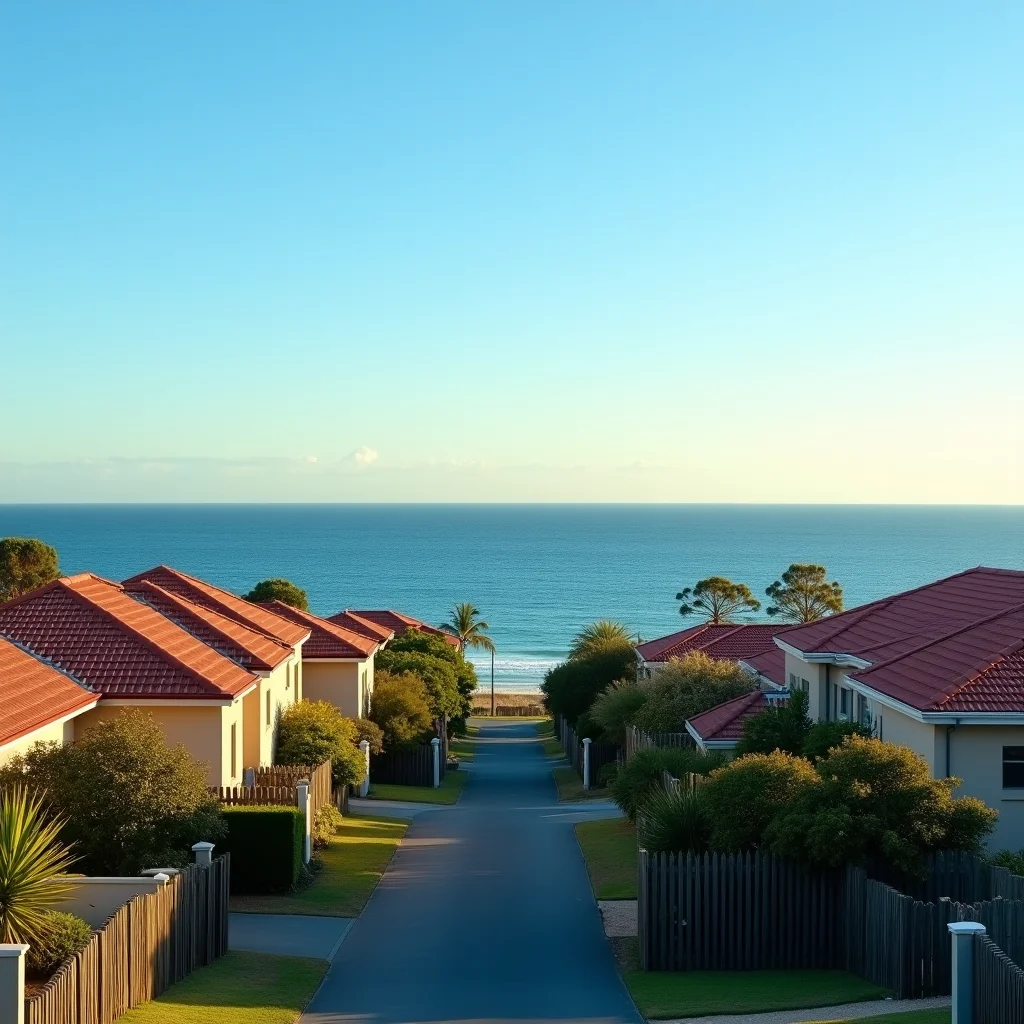
According to REA Group, property listings are spiking in some of Australia's hottest markets as vendors move to capitalise on boom-era price gains — a direct consequence of the sustained interstate migration flows that have repriced Queensland and Western Australia over the past three years. South Perth now records 13.8% annual growth at a $1,450,000 median, selling in just 17 days, while Maroochydore sits at 8.5% growth and a $1,050,000 median with a 28-day sales cycle — both outperforming every Victorian and regional NSW suburb in this dataset by a significant margin. With the RBA cash rate holding at 4.35%, the listings surge signals vendors in high-growth interstate migration destinations are locking in gains before any further rate-driven price softening.
The Migration Dividend: How Population Flows Created Queensland and WA's Listings Boom
Interstate migration to Queensland and Western Australia accelerated sharply from 2021 onward, and the property market data for July 2026 confirms those flows have not reversed. Vendors who purchased in Maroochydore, South Perth, and Mandurah during the early migration wave are now sitting on substantial equity — and the listings spike reported by REA Group reflects a cohort of owner-occupiers and investors choosing to monetise those gains. In Mandurah, annual growth stands at 10.5% against a $550,000 median, with the suburb clearing stock in 24 days and posting a 56% auction clearance rate. That combination of affordable entry price, double-digit growth, and sub-30-day sales velocity is precisely the profile that continues to attract relocated buyers from Sydney and Melbourne.
The interstate migration story is not uniform within destination states. Maroochydore at $1,050,000 and Indooroopilly at $1,380,000 both record 8.5% annual growth, suggesting that Queensland's mid-to-upper price band is absorbing significant migration-driven demand across both coastal and suburban corridors. West End in inner Brisbane records 8.8% annual growth at a $1,350,000 median with a 22-day sales cycle and 62% clearance rate — an inner-urban result that reflects both domestic migration from interstate and the displacement effect of higher-price coastal markets pushing buyers toward city fringe alternatives. For agents operating in these corridors, the listings spike represents an opportunity to convert recent buyer demand into vendor mandates, particularly where migration-era purchasers have held for three-plus years and achieved equity above mortgage balances.
South Perth's 13.8% Growth and 17-Day Sales Cycle Set the WA Benchmark
South Perth's performance data stands apart from every other suburb in the July 2026 dataset. A 13.8% annual growth rate, $1,450,000 median price, 17-day median days on market, and 63.5% auction clearance rate place it in a category occupied by no Victorian equivalent. Toorak — Victoria's prestige benchmark — records just 4.5% annual growth at a $2,800,000 median with a 23-day sales cycle, and Kew posts 4.4% growth at $2,100,000. The divergence is not explained by price point alone; it reflects structural demand driven by WA's economic conditions and the sustained in-migration from eastern states that has compressed available stock in Perth's inner-ring suburbs.
Nedlands, Perth's other high-performance suburb in the dataset, records 15% annual growth at a $2,200,000 median and a 15-day median days on market — the fastest sales cycle across all 20 suburbs tracked. The 65.5% auction clearance rate confirms active buyer competition rather than distressed vendor discounting. Together, Nedlands and South Perth illustrate how interstate migration into WA has concentrated demand at the premium end of the Perth market, compressing supply and accelerating price discovery in a way that Sydney and Melbourne prestige markets are not currently experiencing. For context, for macro and interest rate market analysis on how RBA policy is differentially affecting state-level property markets, the divergence between WA's prestige suburbs and their eastern counterparts has become one of the more striking data points of the 2026 cycle.
Victoria and Regional NSW: What the Migration Outflow Leaves Behind
The same migration dynamic that is generating listings booms in Queensland and WA is suppressing demand in Victoria's mid-market and regional NSW. Dandenong records just 2.3% annual growth at a $680,000 median with a 40-day sales cycle and a 56% clearance rate — a result that reflects both reduced interstate buyer interest and a local buyer pool constrained by the RBA's 4.35% cash rate. Reservoir posts 2.8% growth at $880,000 with a 32-day median, and Prahran sits at 3.9% growth and $1,550,000 with a 25-day cycle. None of these suburbs are experiencing the supply compression that characterises Perth and Queensland's high-migration corridors.
Regional NSW tells a similar story. Port Macquarie records 3.5% annual growth at an $850,000 median with a 48-day sales cycle — the longest in the dataset — and a 46% clearance rate. Ballina posts 4% growth at $1,350,000 with a 45-day median. Both markets experienced a pandemic-era migration surge that has now normalised, leaving a higher supply base relative to demand. Agents in these markets are contending with longer campaign timelines and a buyer pool that has partly relocated to Queensland coastal alternatives like Maroochydore, which offers comparable coastal lifestyle at a similar price point but with meaningfully stronger recent growth momentum. For buyers considering regional NSW versus Queensland coastal markets, understanding how auction clearance rates signal underlying demand conditions is critical to interpreting these diverging results.
South Perth's 17-day median days on market and 13.8% annual growth rate sit 31 days faster and 11.5 percentage points higher in growth than Port Macquarie's equivalent figures — the widest state-to-state performance gap in the July 2026 dataset, driven directly by differential interstate migration flows into WA versus regional NSW.
The Listings Spike Signal: What Rising Supply Means for Migration-Destination Markets
REA Group's reporting of a listings spike in hot state markets introduces a nuanced dynamic for migration-destination suburbs. Rising supply in markets like Queensland's Sunshine Coast and Perth's inner ring could signal the early stages of a vendor confidence peak — where sellers who benefited from migration-driven price growth choose to exit before conditions soften. In Maroochydore, the 28-day median days on market and 54% clearance rate suggest the market remains active but not as compressed as Perth's inner suburbs. A listings increase without a corresponding increase in active buyers — many of whom are still constrained by the 4.35% cash rate — would begin to extend days on market and moderate clearance rates.
For agents in Queensland and WA, the listings spike creates a short-term campaign volume opportunity but also demands careful price guidance. Vendors who list expecting peak-migration pricing in a rising-supply environment risk extended campaigns and price reductions — particularly in mid-ring suburbs where the migration cohort is more price-sensitive. In contrast, inner-ring suburbs with genuine scarcity constraints, such as West End at a 22-day median and South Perth at 17 days, are less exposed to supply-driven softening because the underlying land supply is genuinely constrained. The distinction between scarcity-driven and migration-driven price growth matters considerably when advising vendors on campaign timing and reserve pricing.
It is also worth monitoring the foreign investor dimension of this demand story. According to REA Group, Japanese investors are surging into Australian residential property as Chinese investors — historically the largest foreign owner group — begin offloading holdings at scale. The Australian Property Forum reports this shift is reshaping foreign capital flows into Brisbane, Perth, and Adelaide — markets that overlap significantly with domestic interstate migration destinations. If Chinese investor divestment adds supply to the same corridors where Japanese buyers are entering, the net effect on pricing will depend on volumes and price points, but agents in Brisbane and Perth inner suburbs should be aware of this additional supply variable when modelling vendor campaigns. For background on how foreign ownership shifts interact with market pricing transparency, the REAStats guide to Auction Underquoting in Australia — How It Works, Why It Happens, and Your Rights covers how price signalling in competitive markets can be distorted when demand composition shifts rapidly.
Agent and Vendor Strategy Implications for Migration-Corridor Markets
For vendors in South Perth, Nedlands, West End, and Maroochydore, the current data supports campaigns that test auction clearance at reserve prices reflecting recent comparable sales — clearance rates of 63.5%, 65.5%, 62%, and 54% respectively indicate that conditional buyers remain active, but not universally so. The 4.35% RBA cash rate is still constraining borrowing capacity for owner-occupier migrants relocating from Sydney or Melbourne, which means campaigns pitched above the median risk sitting — particularly in Maroochydore where the clearance rate is below 60%. Private treaty with clear price guidance may generate faster outcomes in mid-market Queensland coastal suburbs where buyer pools are more rate-sensitive.
For buyers targeting migration-destination markets, the listings spike identified by REA Group is a genuine negotiating signal. Increased supply in a rate-constrained environment improves buyer selection and may moderate vendor expectations on price — particularly for properties that have been on market beyond the 28-day Maroochydore median. Buyers entering Mandurah at the $550,000 median with 10.5% annual growth behind it should assess whether the migration driver — affordability relative to Perth and eastern capitals — remains intact, or whether price growth is beginning to erode the entry-level advantage that attracted the initial wave of interstate purchasers. At $550,000 versus Sydney and Melbourne equivalents, Mandurah still offers a substantial affordability differential, but the gap is narrowing with each year of double-digit growth.