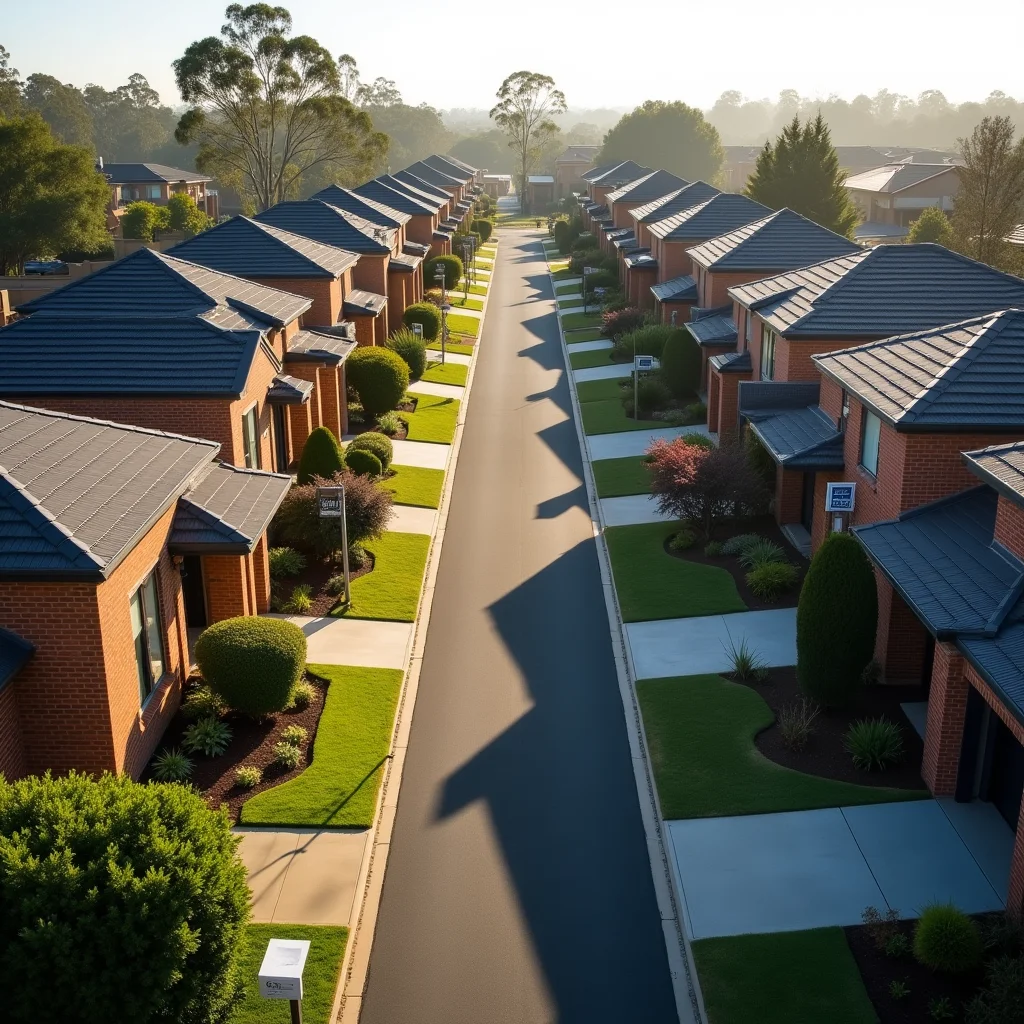
According to REA Group, Sydney's traditional spring market frenzy is in a high-stakes standoff as interest rate fears suppress buyer confidence — yet that same week, a Wentworth Street home in South Hobart drew 35 groups through its first open and sold within seven days. The contrast cuts to the core of what seasonal campaign strategy actually means in 2026: spring is not a rising tide that lifts all listings, and agents who treat it as one are leaving vendor outcomes to chance.
Sydney's Spring Standoff: What the Clearance Data Is Telling Agents
REA Group's September 11 report on Sydney's spring market identifies a clear bifurcation: the cheapest suburbs are recording the highest demand, while mid-to-upper price bands are sitting with rate-anxious buyers refusing to commit. This pattern is visible in the REAStats suburb data. Randwick, with a $2,400,000 median, is posting a 73.5% auction clearance rate and 23 days on market — a strong result. But Port Macquarie, at a lower $850,000 median, is clearing at just 46% with a 48-day sales cycle. The price-band story in regional NSW is the inverse of what Sydney's inner-east is producing, which means a single "spring campaign" template applied across both markets will fail at least one of them.
Kirribilli ($2,650,000 median, 72.5% clearance, 24 days on market) and Surry Hills ($1,920,000 median, 73% clearance, 23 days) tell agents that premium inner-Sydney stock is still clearing efficiently where presentation and pricing are tight. The problem is buyer depth at those price points is thinner than it appears — rate fears mean fewer registered bidders per auction, and vendors who miss a clearance in October may find November conditions materially worse as fixed-rate mortgage resets accelerate into the year's end.
South Hobart's 7-Day Sale: The Counter-Seasonal Signal
The Wentworth Street result reported by REA Group on September 11 is more than an anecdote. Multiple offers, 35 buyer groups, and a sub-seven-day sale in a market that is not typically a spring hotspot signals that pent-up buyer demand is geographically concentrated — and will respond aggressively when the right property comes to market, regardless of the calendar. For agents, this is a direct argument against delaying listings until peak spring week-counts arrive. In markets with constrained stock and motivated buyers, early-spring or even late-winter launches can capture concentrated demand before competition from new listings dilutes buyer attention.
The South Hobart result also illustrates the value of open home logistics as a campaign signal. When 35 groups attend the first open, an agent with a strong pre-registered buyer database can accelerate to a contracted sale within the same week — compressing the campaign to its most efficient form. The data from WA supports this: Nedlands is averaging 15 days on market with a $2,200,000 median and 15% annual growth, while South Perth clears in 17 days with 13.8% annual growth. Both markets are posting sub-25-day campaigns because buyer pools are deep and pre-qualified, not because agents are running longer spring campaigns.
The Days-on-Market Gap That Seasonal Strategy Must Bridge
The REAStats data reveals a 33-day performance gap between the fastest and slowest markets currently in play. Nedlands (15 days), South Perth (17 days), West End QLD (22 days), and Toorak (23 days) sit at one end. Port Macquarie (48 days), Ballina (45 days), Dandenong (40 days), and Liverpool (38 days) sit at the other. This is not a spring-versus-other-season problem — it is a structural demand problem that seasonal campaigns alone cannot resolve.
Port Macquarie's 48-day median sales cycle and 46% auction clearance rate represent a 27.5-point clearance gap versus Randwick's 73.5% — the widest state-level divergence in the September 2026 REAStats dataset. In this environment, running a standard four-week auction campaign in Port Macquarie without a private treaty fallback exposes vendors to post-auction price erosion at the worst moment of the selling cycle.
For agents operating in slower-velocity markets like Ballina (45 days, 47% clearance) or Dandenong (40 days, 56% clearance), the campaign design question is not whether to list in spring — it is how to sequence the method of sale. Private treaty with a defined vendor review date, rather than a fixed auction day, gives agents the ability to manage price expectations through the campaign without the public pass-in risk that undermines vendor confidence in soft clearance environments.
Eastern Suburbs Auction Results and the Bidder-Count Indicator
The SMH Property report from September 12 on the eastern suburbs apartment — which sold $62,000 above reserve with 12 registered bidders, nine more than expected — points to a specific price-band dynamic that agents should factor into seasonal campaign design. At accessible price points in high-demand inner-city locations, buyer competition is compressing reserves and generating above-guide results. The agent quoted in the piece attributed the result to the price range's popularity, which aligns with REA Group's spring standoff analysis: cheapest-relative suburbs in premium precincts are outperforming on bidder depth.
The implication for campaign strategy is direct. Agents listing in markets like Maroochydore ($1,050,000 median, 28 days, 54% clearance) or Fremantle ($950,000 median, 25 days, 54.6% clearance) — where price points sit below metro premium thresholds but above regional affordability floors — should expect bidder registration numbers to be a leading indicator of result strength. Pre-campaign buyer qualification and database canvassing in these markets should be completed before the first open home, not during the campaign week.
Understanding agent performance through a quantitative lens is central to this analysis. The REAStats guide on how to measure real estate agent performance outlines why days on market, vendor discounting, and clearance rate benchmarks must be read against local conditions — not national averages. For international property market comparison, Australian spring selling season conditions in 2026 are unusual: rate-suppressed buyer confidence coexisting with geographic pockets of acute supply shortage.
Campaign Timing and Method-of-Sale Decisions Under the RBA's 4.35% Cash Rate
With the RBA cash rate holding at 4.35%, buyer borrowing capacity remains constrained across all markets. The strategic response for vendors and their agents is not to wait for a rate cut — PropTrack's data through August 2026 already records a 2.7% decline from the March 2026 price peak — but to engineer campaign conditions that maximise competition within existing buyer pools. That means front-loading buyer engagement: database outreach before listing, pre-registered bidder targets before the first open home, and a clear vendor brief on reserve pricing anchored to current comparable sales rather than 2024 peak values.
In Queensland, where West End ($1,350,000 median, 8.8% annual growth, 22 days) and Indooroopilly ($1,380,000 median, 8.5% growth, 23 days) are running tight campaigns with 62% to 62.5% clearance rates, agents have spring conditions that reward early listing and auction methods. The growth rates are among the strongest outside WA, and the days-on-market figures suggest buyer pools are active. By contrast, Maroochydore's 54% clearance rate and 28-day cycle suggest that while Queensland coastal markets are growing at 8.5%, the buyer pool depth at auction is thinner — private treaty or expressions of interest may generate stronger outcomes for vendors than a fixed auction date.
For vendors considering their timing and method of sale, the vendor advocacy framework at REAStats provides a structured approach to evaluating agent campaign recommendations against suburb-level data. In a market where Toorak clears at 72% in 23 days and Dandenong clears at 56% in 40 days — within the same state, under the same RBA rate — the difference in outcome is primarily a function of campaign design and buyer pool management, not market forces alone.
The September 2026 data is unambiguous: seasonal campaign strategy must be built from suburb-specific clearance rates, days-on-market benchmarks, and current bidder depth — not from the assumption that spring automatically generates competition. Agents who front-load buyer qualification, choose method of sale based on local clearance data, and price reserves to current comparable sales will outperform those following a generic spring playbook. Vendors in slow-velocity markets like Port Macquarie and Ballina should expect 45-to-48-day campaigns and structure their personal timelines accordingly, while vendors in Nedlands, South Perth, and inner-Sydney eastern suburbs can pursue compressed campaigns with confidence — provided reserve pricing reflects the rate-constrained buyer pool, not 2024 peak expectations.